Showing posts with label Western. Show all posts

Thursday, October 15, 2020

A Lady Takes a Chance

The 120 Screwball Years of Jean Arthur Blogathon is an event celebrating the life and career of the actress, hosted by The Wonderful World of Cinema. For more information on participating bloggers, visit the link at the host site.

A Lady Takes a Chance

YouTube viewing 

Well, this movie sure has an unusual pairing: 30s romcom girl Jean Arthur, she of the squeaky voice and slightly-odd-but-still-cute looks, and John Wayne, on the verge of becoming the iconic superstar of the great John Ford westerns, together in a romantic comedy. Huh?

A Lady Takes a Chance realizes they’re an odd couple—from the perspective of a 21st century cinephile, she belongs with Jimmy Stewart and he belongs with Maureen O’Hara—but here they are. Can they believably fall in love with each other despite coming from not only different worlds but different genres?

The film begins with a message on title cards that has a surprising amount of resonance in 2020, a year that has made us all nostalgic for 2019:

“Once upon a time... It was so long ago that people drove sixty miles an hour, and skidded their tires, and drank three cups of coffee all at once, and ate big gobs of butter, and there were more fellows around than there were girls, and everybody was having a good time without knowing it, that’s when our story happened. Away back then... in 1938.

“And here’s hoping that ‘once upon a time’ goes on again some quick tomorrow. 

“Only better.”


Monday, June 29, 2020

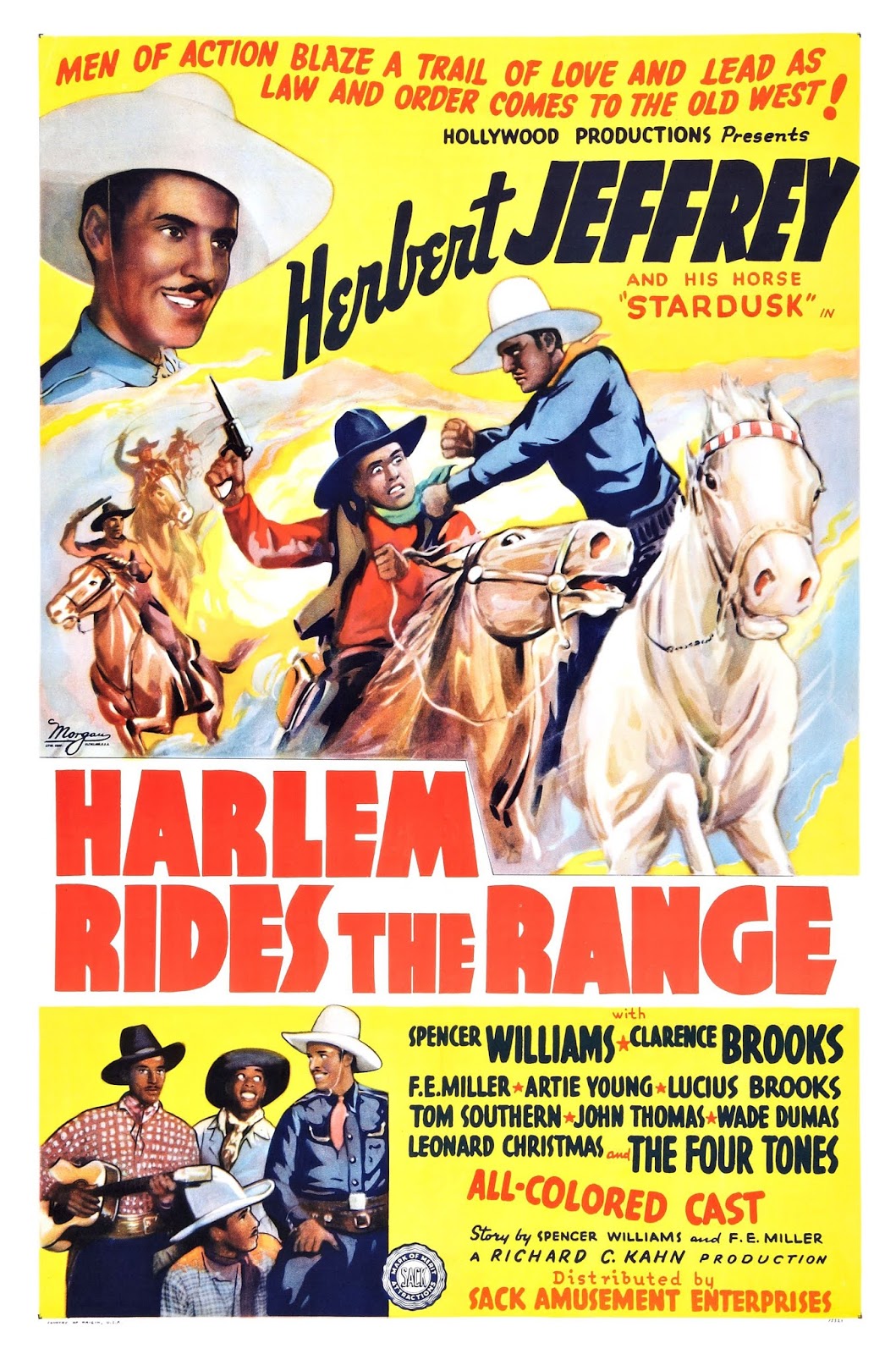
Harlem Rides the Range

Harlem Rides the Range
YouTube viewing

I really wanted to write about a black cowboy movie but thought I’d have to settle for one from the 70s or 80s. Then I came across this discovery: Herb Jeffries (AKA Herbert Jeffrey) was a singing cowboy from the 30s who starred in westerns with all-black casts.

He was very light-skinned (his mom was white) but identified as black. He started out as a singer in Detroit and moved to Chicago. In 1931 he joined Earl Hines’ band for a few years and then moved to LA in 1934. In time he became part of Duke Ellington’s band and lowered his vocal range to sound more like Bing Crosby.

While touring in the South with Hines, Jeffries experienced racism for the first time; the band could only play in tobacco warehouses and black-only theaters. When he saw black kids watching westerns, he decided they should have a black cowboy hero of their own.

He hooked up with producer Jed Buell, raised some money and wrote songs for the film. Jeffries had learned about horse riding on his grandfather’s farm, so he cast himself in the lead and used makeup to darken his skin.


Harlem on the Prairie was shot in five days in 1937 and though the critical reaction was mixed, it got a write-up in Time. “The Bronze Buckaroo” went on to make three more westerns, including the one I watched, Harlem Rides the Range, from 1939. I’m sorry to say it’s not very good; the acting is amateurish, the editing uninspired and there are only two songs in the hour-long movie.

That said, Jeffries was a good singer and the fact that his movies got made at all is an accomplishment in itself worth noting. He appeared in other non-western movies and television later in life, including an episode of The Virginian. A documentary short, A Colored Life, was made about him in 2008.


Saturday, June 27, 2020

Gene Autry vs. Roy Rogers

Singing cowboys (and cowgirls) have been around almost as long as sound in motion pictures. I can’t say I have much experience with them. I remember some of the country records my father listened to by self-styled cowboys—Marty Robbins, Freddy Fender, Tex Ritter—but as a kid, I never associated singing cowboys with the movies. I suppose my father must have watched singing cowboy movies growing up and then later, as an adult, but I don’t recall seeing any on TV.

If you had asked me back then, I would’ve said Gene Autry was the owner of the California Angels and Roy Rogers was the fast food restaurant. Even when I discovered who they were beyond those roles, I can’t say I cared much; westerns were what my parents watched. Now, many years later, as I re-examine westerns, it occurs to me that my education would be incomplete without a foray into the sub-genre of the western musical, and the two guys who dominated the field like oil rigs on the plains of Texas.

Here’s a top ten list of singing cowboys and cowgirls featuring some names you may not know. Here’s a history of the sub-genre, with a heavy focus on Autry and Rogers. With this post, I’m mostly interested in seeing their movies (and a bit of their TV shows) and seeing which one of them I like better. I realize I’m working from a small test sample, given the breadth of their careers, but I’m guessing their movies followed a formula and rarely strayed from that formula. My small sample will probably be enough.

Wednesday, June 24, 2020

The Maverick Queen

The Maverick Queen
YouTube viewing

This is pure speculation on my part, but I’m guessing Pearl Grey realized from an early age he needed to change his name and become famous for something, so no one would ever have to call him “Pearl” again. Good thing he went with his middle name instead and became the Western writer Zane Grey.

Before Larry McMurtry, before Louis L’amour, there was Zane Grey. His novels and stories redefined the Wild West for a generation of readers, and needless to say, they were translated into numerous films and TV episodes. There is a Zane Grey Museum, in Lackawaxen, Pennsylvania, the town where he lived after his marriage for a time.

Grey played baseball; he was a pitcher and then an outfielder at the University of Pennsylvania and had a cup of coffee with the Pittsburgh Pirates in 1903. For a time, he followed his father in the field of dentistry, but what he really wanted to do was write.

Monday, June 22, 2020

Decision at Sundown

Decision at Sundown
YouTube viewing

Would you follow a man on a mission of revenge?

In the old west, disputes were settled from the barrel of a gun, and wrongs done a man were never forgotten. Sure, it may take years, time that could be better spent thinking about it and realizing it’s probably not worth nursing a vendetta for quite so long and moving on with life instead—settling in a town with a peculiar yet ironically fitting name somewhere, getting a steady job punching cows, marrying an ordinary-looking girl but keeping the town whore’s address in your little black book, having a couple of kids and developing a drinking habit that’ll ensure you die before the age of forty, which was just about the average life expectancy of most people in the old west anyway—but you don’t care! Because a man’s gotta do what a man’s gotta do, or at least what the screenplay tells him to do. Would you devote your life to seeing justice done, even if you may not have all the facts or may not be sure it even is justice?

You’d do it—for Randolph Scott!

Thursday, June 18, 2020

Television: Wagon Train

Gene Roddenberry first pitched Star Trek to NBC in April 1964. The ex-policeman turned television writer-producer had made in-roads into the new medium with scripts for anthology series and briefly had a short-lived military series called The Lieutenant, but longed for the ability to address social issues without contending with conservative network censors.

He knew science fiction was a tough sell though, so when he entered the office of producer Herb Solow, he nervously handed him a piece of paper with his treatment on it and likened his proposed series to something more familiar: a western. Specifically, a western that had been going strong since 1957, on two networks, called Wagon Train.

Spun off from a 1950 John Ford movie, Wagon Master, it lasted eight seasons and 284 episodes on first NBC, then ABC. The original stars, Ward Bond (from the original movie) and Robert Horton, were together for the first four seasons. The show centered around a wagon train, obviously, of 19th-century settlers moving to Oregon, led by Bond. Horton served as advance scout for the train. There were also recurring characters who worked with Bond and protected the settlers. The executive producers were Howard Christie and Richard Lewis.

I never gave much thought to the Trek connection (however loose it is), but I watched it wondering how much WT was like Trek, if at all. My conclusion: not that much, but maybe it’s not that obvious based on only three random episodes?

Monday, June 15, 2020

Warlock

Warlock
YouTube viewing

He was never as big a star as the other two guys. The show made him a star within its context; he did little work outside of it—but because the show was and is so beloved, so cherished, the brand of stardom bestowed upon him probably felt almost as big as the other two.

DeForest Kelley would’ve turned 100 this past January. We still remember him because of the passion, courage and humor he brought to one of the greatest shows in television history. His role was the conscience of the show, its emotional heart that served as the counterbalance to its intellectual side, and he did it memorably and well.

Long before he went where no man had gone before, though, he had a successful career in a far different context: the western.

Friday, June 12, 2020

Hell’s Hinges

Hell’s Hinges
YouTube viewing

Jeanine Basinger described William S. Hart the following way in her book Silent Stars:
His eyes contain no warmth, no little twinkle to signal to the audience that he actually has a heart of gold; in fact, his eyes are mean—small and hard. He gives off no sign of emotion or attitude, no hint of what he may do next. He just stands there, like a rock in Monument Valley, and it’s up to us to figure him out. He doesn’t even seem to be an actor. Rather, his presence seems to say, “This is what a western hero looks like”—his behavior, his look, his truth. Whatever action Hart takes will explain what the American West was all about.
While watching him in the film Hell’s Hinges, my initial impression was he reminded me of Gary Cooper: tall, laconic, taciturn. Unlike Cooper, Hart did seem to have a hardness to his on-screen presence, a quiet intensity that burned even in his vulnerable moments.

Before John Wayne, before Randolph Scott and Joel McCrea and Roy Rogers, there were two big-name western stars: Tom Mix and William S. Hart, and they dominated the silent era. Perhaps I’ll talk about Mix another day. Today it’s all about Hart.

Wednesday, June 10, 2020

The Outlaw

The Outlaw
YouTube viewing

I was going to spend this post about The Outlaw talking about Howard Hughes, about the real Billy the Kid and Doc Holliday and Pat Garrett, but the truth is, this is such a bad movie that I can’t be bothered—and I was disappointed, too, because Walter Huston is in it and I had enjoyed every other film of his I had seen—even Kongo! And this is all before I get to Jane Russell.

No one in it acts like a normal human being. (Well, maybe the middle-aged Mexican woman does. Her I liked.) The major bone of contention between Billy and Doc is over a horse. I swear to god they fight over this horse for most of the movie. They fight over Russell, too—she starts out with Doc but ends up with Billy—but at one point, when offered the choice of Russell or the horse, Doc actually chooses the horse.

HE CHOOSES THE HORSE OVER JANE FREAKING RUSSELL.

Think about that.

Monday, June 8, 2020

Stagecoach (1939)

Stagecoach (1939)
YouTube viewing

My parents were part of a generation that revered westerns. My mother still watches them, mostly TV shows on one of the nostalgia channels. It’s difficult to say whether or not she has a passion for them like I have one for, say, Star Trek.

If you were to ask her, she probably could list a favorite show or a favorite movie, but to articulate further about it—favorite episodes, characters, actors—might be harder, but then, the fan mentality isn’t something that comes easily to her, if at all. I suspect she still watches westerns out of habit. I never get the sense from her of “Oh boy, here’s that Bonanza episode where Hoss gets a rhinoplasty; I can’t wait to see it again.”

For the so-called “greatest generation,” though, as well as the Boomers that followed, westerns were a big part of their cultural identity. That’s something I’ve understood intellectually as a Gen X-er, but to me it’s another genre, like spy thrillers or mysteries. I have my favorite movies and actors, of course, but I’ve never really gotten why it was as huge as it was in its heyday.

Guess what we’re gonna be talking about this month, kids?

Disclaimer: we all get that these movies and TV shows were made during a time when knowledge and appreciation of the Wild West as it really was, relations between Indians and whites, gender roles, etc., was limited and biased. We acknowledge the stereotypes and distortions of history without taking them to heart and will opt to find the good in these stories regardless—and there’s plenty of good to be found.

Friday, August 2, 2019

Furry links

So what do I think about that Cats trailer? Now that you’ve heard everyone else’s opinion...

Back in the 90s, I saw on VHS a production of the Broadway show, so I’m familiar with it. I always thought it was peculiar. This, though, is on another level. The trailer didn’t freak me out as much as it did some people—I stayed up half the night watching “reaction” videos on YouTube—but yeah, turning the cast into CGI human-cat hybrids may not have been the wisest decision. (On the other hand, we now know a Thundercats movie is possible!) It’s doubtful the fans of the show would have accepted an animated version, though, so this is what we’re left with, not that anybody was clamoring for a Cats movie in 2019 to begin with. Plus, while I can hardly object to Jenny Hudson’s rendition of “Memory”—easily the best thing about that trailer—from the looks of her, I couldn’t help thinking she’s just reprising her role from Dreamgirls.

Still, it is Cats, and because it’s Cats, people will turn out for it, especially at Christmas. It’s one of those things where if you love it, you adore it wholeheartedly. I know; I was the same way with Rent, but that didn’t have CGI human-cat hybrids. So I guess between this and the Lion King remake, this will be remembered as (with apologies to Al Stewart) the year of the cat.

———————

Don’t have too much else to say at the moment, so let’s jump straight to the links:

Why does Paddy love westerns?

Who was “the Marilyn Monroe of Bollywood”? Ruth has the answer.

Ivan discusses a film written by Billy Wilder and Charles Brackett that has become quite relevant in 2019.

Hugh Jackman in concert is quite spectacular, as Hamlette will attest.

Jacqueline looks at which movies were playing the weekend of the moon landing.

Fritzie shows off shampoo ads with silent film actresses.

Judy Garland’s daughter Lorna Luft reflects on her mother’s legacy as a gay icon, fifty years after her death.

Also, a crowdfunding campaign is under way to restore Judy’s birthplace.

What would TS Eliot have made of the Cats movie?

That casting a black girl as the Little Mermaid is still a matter of controversy in 2019 is frankly, embarrassing. But there’s historical evidence that suggests such a thing isn’t that unusual.

The long-term implications of the virtual technology of The Lion King 2019.

Paul McCartney will write the music for a stage musical version of It’s a Wonderful Life.

84-year-old Sophia Loren is working on a new movie directed by her son.

These pics from the demolished site of the former Sunshine Cinema will depress you.

Long before he joined the cast of In Living Color, Jim Carrey appeared in this Playboy Channel movie. (NSFW)

Celebrity memorabilia and the people who buy it.

Friday, April 5, 2019

The Ballad of Buster Scruggs

The Ballad of Buster Scruggs
Netflix viewing

The Ballad of Buster Scruggs is the first Netflix original film I've seen since I got the online streaming service for myself, and it comes for me at an appropriate time. You may recall Scruggs was a three-time Oscar nominee, including Adapted Screenplay, one of several Netflix films from last year to be feted, and that's starting to rub some people the wrong way.

Friday, January 18, 2019

Rawhide (1938)

The Made in 1938 Blogathon is exactly what it says on the tin, hosted by In the Good Old Days of Classic Hollywood and Pop Culture Reverie. For a complete list of participating blogs visit the links at the host sites.

Rawhide (1938)
YouTube viewing

The numbers tell the story of Lou Gehrig, and what a tale they tell: 17 seasons, all with the New York Y-nk--s; lifetime batting average of .340; a seven-time all-star; two-time MVP winner; three-time league leader in home runs; five-time league leader in runs batted in; a Triple Crown winner and owner of six World Series rings.

Plus the most important number of all: 2,130. That's how many consecutive games he played, folks: the equivalent of almost six calendar years without a day off. Though it's no longer a record, it's still a monumental achievement.

His premature death at age 37 raised awareness of the rare condition that took his life, amyotrophic lateral sclerosis, to the point where the disease now bears his name. And perhaps you've heard of the film they made about him.

But did you know he himself once co-starred in a Hollywood movie?

Thursday, April 20, 2017

The Good, The Bad and the Ugly

The Good, The Bad and the Ugly
AMC viewing

I remember, in the time before I got into movies, seeing snippets of The Good, The Bad and the Ugly on TV and wondering why it was dubbed. It wasn't like the Chinese kung fu movies or the Japanese monster movies I'd also watch. It was obvious the actors in those movies weren't speaking English, hence the dubbed voices. In this movie, though, while I was no lip reader, it sure looked like everyone was speaking English. So why did their lip movements not match up perfectly with the audio track?

Clearly this was long before I had ever heard the phrase "spaghetti western."

Sergio Leone is rightly revered for making some of the most iconic westerns of all time, films that redefined the genre and made a superstar out of Clint Eastwood, but did you know he only directed seven movies total? The Italian, the son of a director and an actress, toiled as an AD for many years in Italy and the US before switching to screenwriting, and ultimately, directing. There were precedents for westerns made in Italy and the rest of Europe, but when Leone made A Fistful of Dollars in 1964, that was when the sub-genre busted wide open.


I saw A Fistful of Dollars, For a Few Dollars More and GBU during my video store days, as well as Once Upon a Time in the West, but one day I'd like to see any of them on a big screen. My new flatscreen TV is big, and it provides a measure of the grandeur of the movie's sprawling mountain vistas and desert terrains, but this was shot in the 2.35:1 aspect ratio. That's wide, folks. I mean hella wide. A film like this kinda demands to be seen the way the director intended.


As enjoyable as GBU is, it's really long. I think last week was the first time I had seen the whole thing through, start to finish. By the time Blondie and Tuco reach the bridge and the Union soldiers, I was beginning to zone out. When Tuco runs through the cemetery, the spinning camera shots are long and practically vertigo-inducing. And the final showdown between Blondie, Tuco and Angel Eyes is dragged out to an almost ridiculous length. All those shots of their eyes in super close-up, over and over - oy!


What makes all that enjoyable, though, is the distinctive music of Ennio Morricone. Melodramatic, yet emotional, memorable and sweeping, it's everything you want a film score to be. The tension in the final standoff is induced by the music, as it gets higher and more intense, waiting for someone to shoot somebody. It's marvelous.

Is Blondie really "good"? He runs a scam on people, one that puts his partner Tuco in serious danger every time. Then he betrays Tuco for no good reason. Is it any wonder Tuco wants revenge? I would say Leone was being ironic with that title, but this doesn't strike me as that kind of movie.

Friday, July 29, 2016

Shane

Shane
TCM viewing

In one of my favorite 90s action movies, The Negotiator, there's a scene in which Kevin Spacey and Sam Jackson debate the ending of Shane. The latter says Alan Ladd is alive, despite the gunshot wound he took. The former insists he's actually dead as he rides off on his horse. They never settle the matter definitively.

Maybe it was my TV, which is pretty old and starting to show signs of wear. Maybe it was TCM's print. I don't know, but the ending looked so dark it was really tough to even make Ladd out! Most of the night scenes in Shane were like this, in fact. I'm not sure if this was director George Stevens' intent or not. All I know is the movie looked darker than I had remembered.

Okay, I'm just gonna put this out there and damn the consequences: the kid in this movie was totally in love with Shane. I can't be the only one to pick up on this, am I? I mean, he was crushing hard on Shane from the moment he appeared. I think at one point, he even tells Jean Arthur he loves Shane. I know, I know, it wasn't meant to be interpreted as romantic love, but it's hard to ignore the subtext in the scene where Shane teaches him to shoot a gun... I wouldn't even mention it, except the movie plays up the kid's hero worship of Shane almost to the point of comedy. It wasn't exactly subtle.


The mountains of Wyoming frame many of the outdoor scenes. They're magnificent. Shane was shot in Wyoming's Jackson Hole Valley, an area which encompasses, among other things, the Grand Teton National Park and the National Elk Refuge. I believe the animal the kid watches in the beginning of the film was an elk. They're bigger than deer but smaller than moose. The Shawnee and Cree Indians call them "wapiti," meaning "white rump."


Ladd was good, but I wanna show some love for Van Heflin. The more I see of him, the more I like. Between this, the original 3:10 to Yuma, and The Strange Love of Martha Ivers, he did some quality work. He wasn't flashy; that usually wasn't his role. He provided stability while all the crazy stuff's going on around him. Here, he and Ladd get into a great barroom brawl scene, going up against a bunch of bad guys together, and you can tell the experience bonds them. Plus, he gives a good rally-the-troops type speech in the second half of the film.


Despite the presence of the kid, this isn't an overly sentimental movie, which I appreciate. Like Clint Eastwood in Unforgiven, one gets the impression Shane was trying to put his violent ways behind for good, but circumstances wouldn't allow that to happen. That's probably why he leaves at the end - he knows he can't be around decent people for too long. It's a good movie. I can see why it's so beloved.

Monday, July 11, 2016

Les Cowboys

Les Cowboys
seen @ Lincoln Plaza Cinemas, New York NY

Les Cowboys was a movie Vija had suggested for our movie group and I went to see it only because I hadn't seen her in a few months. I had nominated a different movie on our Facebook page, but apparently something very bad happens to a dog in it, which didn't go over well with the animal lovers in our little group, so Vija recommended this instead. All I knew about it came from a single review I had read which seemed positive, but with reservations. Didn't matter, though. I had taken the Sunday off from my writing group and needed something to do, and seeing a movie, any movie, with Vija certainly appealed to me. So I went.

There was just one problem: I could barely see because gremlins stole my glasses. (That's my story and I'm sticking to it.) When I had agreed to see the movie, I had kind of forgotten about this unexpected complication. By the time you read this, I'll have a new pair, which in truth, I've needed for months at least, but I had to spend a little over a week going through the world without them. Why so long? The holiday weekend, of course. It slowed down the manufacture of my new pair after I went to the neighborhood eyewear boutique for an eye exam.

I've worn glasses most of my life. Wearing them has become second nature to me, to the point that feeling my face without them when I normally expect to wear them feels wrong. Enduring a week-plus of squinting at signs, holding books up closer to my face, and guessing at the layouts of unfamiliar places made me realize how much I take them for granted. This one dude in my writing group told me how he got laser-corrective surgery done on his eyes, which he said were pretty bad. I said I'd be too scared to have that done to my eyes, even though it's a fairly common practice by now. I dunno. Maybe it's worth considering before I get too old.


Despite the change of movie, most people couldn't make it, so it was just me and Vija and Franz. I had to talk them into sitting in the front of the theater. I think we were in the fourth row, but the screen was set far enough back that we weren't looking up into the actors' nostrils. I had feared I might need assistance from Vija in interpreting the occasional subtitle (and so had she!), but they were big enough that I could read them, and as a plus, a number of scenes were done in English.

Les Cowboys, a French movie, was a modern riff (though not a remake) on The Searchers: dude's teen daughter appears to have been abducted by her boyfriend, but after a few days, she sends a note saying she chose to elope with him and to not bother coming after her. Dad is not convinced, however, so he and his son set off in pursuit. Muslims are substituted here for Indians. The timeline for the story begins before 9-11 and stretches past, hitting a few other notable events along the way, including the train bombings in both Madrid, in 2004, and London, in 2005. Plus, John C. Reilly!

Dad, his family, and their friends, are really into American Western culture; they have square dances and sing country songs and wear cowboy hats, hence the film's title. It's a bit odd to hear a song like "The Tennessee Waltz" sung with a French accent. I have no idea how widespread this sort of thing is in France; you just have to accept this for the sake of the story, although it doesn't play much of a factor at all. I think it's only there to make the Searchers comparisons more overt. There are also scenes of people riding the plains of Afghanistan on horseback which kinda look like they were cribbed from a Western.


Long story short, Vija and I liked the film and Franz didn't. He seemed to think the depiction of European Muslims was off - a Colombian, he spent some time in Paris before he met Vija, so I bow to his superior knowledge in this - but he also nitpicked at the writing and acting, which didn't seem anywhere near as bad as he claimed.

See, the problem with talking about movies with Franz is, while he's basically a good guy at heart, he's also a bit eccentric, to the point where he can come across as excessively dogmatic when expressing his opinions. I know because I've tried debating him on movies in the past and ended up frustrated at his intransigence. During the movie, he kept whining to Vija about this and that scene he didn't like, and she kept shushing him - not the first time this has happened. It reached the point where I had to tell him to shut up. Fortunately, the theater was only about half-full, so he didn't embarrass us, at least.


Neither of them has seen The Searchers, so I had to describe it to them in the context of Les Cowboys. The French film takes a sudden and dramatic second-act twist which deviates sharply from the American film, but parallels still exist. Like John Wayne's Ethan Edwards, the father in Les Cowboys, Alain, has a bias against the culture connected to the alleged kidnapping, and the fear that the Natalie Wood surrogate, the daughter Kelly, has assimilated into that culture, is present. The Jeffrey Hunter surrogate, the son Georges, eventually comes to see things differently than his father over time.

Both films are concerned with how whites look upon "the other" in extreme situations. Searchers exposes the prejudice that lies underneath the mythology of the American West, the same mythology that the family of Les Cowboys celebrates, despite its origins in another country. There can be no reconciliation in Wayne's heart over what happens to Wood; he wants to kill her because of it, and would have if Hunter hadn't interfered. In the end, Wayne is left alone, on the outside, as Wood is reunited with her family. Les Cowboys ends on a note of acceptance, despite the anti-Muslim sentiment witnessed to that point. It's a message we could use now more than ever.

Thursday, July 23, 2015

Joel McCrea

For a long time, I underestimated Joel McCrea. I never disliked him, but I never saw him as anyone particularly special, at least not compared to more dynamic actors like Jack Lemmon or William Holden or Burt Lancaster. McCrea always struck me as kinda vanilla by comparison.

At first, there were his films with writer-director Preston Sturges, Sullivan's Travels and The Palm Beach Story. At the time I watched them, I remember knowing more about Sturges than McCrea, so it's possible that I was more caught up with the dialogue than with the actors in those movies. 

This would've been during my early video store days, when I was still learning about major directors and actors. Someone like McCrea would've gone under my radar, except I distinctly remember one day when Bill, my manager, put on These Three. McCrea's name is under the title, after the names of the stars Miriam Hopkins and Merle Oberon, and when I saw that, I thought perhaps his name was pronounced mac-CREE, so that it would rhyme with "three." 

When I started film blogging, I'd see other bloggers write about him in more appreciative tones. but while I saw some more of his movies, I never went out of my way to pay attention to him. To me, he remained an actor who was good, serviceable, sturdy, but not someone I could get excited about.

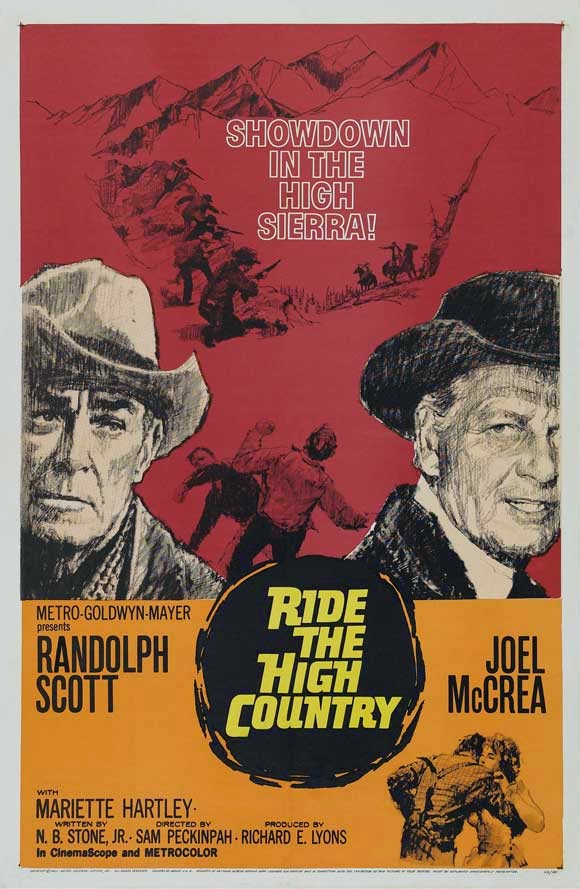
I wouldn't call Ride the High Country an epiphany of any kind, but that was a movie where McCrea surpassed being merely "good" for me. As an older man, especially in a Western setting that was a little bit edgier than earlier Old Hollywood westerns, he had a more authoritative, distinguished air that suited him well, I think. Of course, by the time I saw that, my tastes had evolved to where I could appreciate different kinds of actors. 

Would I put McCrea in my all-time top ten for leading men? No - so why am I writing about him? Because I realize now that he is better than I used to give him credit for. Also, I'm just enough interested in him to want to know a little more about him - and what I've learned is quite interesting indeed.

For instance, did you know McCrea owned a ranch? He wasn't just a movie cowboy, he was one in real life, too! It was built on what eventually became 3000 acres of land in Santa Rosa Valley, California, back in the 30s at the suggestion of none other than Will Rogers, whom McCrea befriended early in his career, as a fallback in case Hollywood didn't work out. He lived there with his longtime wife (57 years!) Frances Dee, and raised their children there. From the photos, it looks beautiful, like something out of one of his many westerns.


McCrea had a TV show - a Western, natch, called Wichita Town (not to be confused with a movie he made called Wichita), which he starred in with his real life son Jody. It was a post-Civil War series about a US Marshall in a growing town. It only lasted one season on NBC. Jody alternated much more between film and television. Perhaps you saw him in such films as Beach Blanket Bingo, How to Stuff a Wild Bikini and The Glory Stompers?

So I think what we've learned here is that sometimes - not always, but sometimes -there's more to an actor than meets the eye.

Next: Thelma Ritter

-----------------------
Films with Joel McCrea:
Banjo On My Knee
Sullivan's Travels
Ride the High Country

Previously:
Jack Lemmon   Jean Arthur
Edward G. Robinson   Rita Moreno
Frank Capra   Bernard Herrmann
Joan Blondell   James Dean
Ethel Waters   William Powell
Tod Browning   Edith Head

Wednesday, March 4, 2015

The Furies

The Furies
seen online via YouTube

Given her early days as a Brooklyn showgirl turned film star of contemporary dramas and comedies, Barbara Stanwyck probably didn't seem like a natural for Westerns at first. The future Big Valley TV star, however, took to them fairly well. According to this Movie Morlocks piece, she had always had an interest in them:
...A political conservative, Stanwyck did not take on these roles to make a point about her gender, and she would likely be uninterested in a feminist interpretation of them. Apparently, the Old West fascinated her, and she once referred to the era’s gunfighters, pioneers, and outlaws as “our royalty, our aristocracy” in an interview. After Stanwyck’s divorce from Robert Taylor was finalized in 1951, she kept their ranch and continued to ride the horses. She was in prime riding shape for the westerns she made during the 1950s, and she was inclined to perform her own stunts. Forty Guns includes a dangerous scene in which her foot is caught in a stirrup, and she is dragged across the prairie, a stunt she did herself when the stuntwoman refused. In The Maverick Queen, her character is chased across the wilderness and forced down a rocky incline, a treacherous maneuver for horses. The stunt required sure hands and a steady seat, but Stanwyck had no trouble pulling it off.
I picked out The Furies to watch because I wanted to watch a western, and one with Stany definitely fit the bill for me. I was also interested in it as an Anthony Mann-directed film. I knew his name as a director of crime flicks and westerns, such as Bend of the River, and I had wanted to sample more of his films. It also had Walter Huston. Sounded like a winner to me.


Was it ever! "The Furies" is the name of a ranch owned by Huston's character, and Stany is his daughter. The movie is basically a power struggle between the two of them for ultimate control of the ranch. Imagine Lady Macbeth as the daughter of King Lear and you'll get an idea of what to expect in terms of tone. I don't think I've ever seen a western quite like this before. Stany is ambitious and seductive in a way few women characters are in westerns, and honestly, the best way to describe the conflict between her and Huston is in Shakespearean terms.

Theirs is a rather unique relationship. At the outset, it's clear that Stany has been made in Huston's image. In fact, he fully intends to leave her The Furies when he passes on, and she's in the process of being groomed for that role. They're more like business partners than parent and child, and the more we see of them together, the more we sense a kind of sexual tension between them. At least, I did!


Stany has a swagger to her here. It's as if she took Phyllis Dietrichson, dropped her into the 19th century frontier, and amplified her sexuality and her nerve - though never in a campy or over-the-top way. We see her sitting with her boots up on her father's desk, doing business with his peers, as he does. For the most part, she is accepted on her own terms. She's almost never looked upon as unusual in any way.

Naturally, she needs a rival, and she gets one in the form of her Strange Love of Martha Ivers co-star Judith Anderson, who catches Huston's eye and seems to have an agenda of her own, which could easily mean pushing Stany out of the picture. This eventually leads to Stany doing something very shocking (I audibly gasped), and from that point on, war is declared between father and daughter.


There's also a subplot involving her seduction of banker Wendell Corey (with whom she also appeared in The File on Thelma Jordon in the same year, 1950, as The Furies), and theirs is also a twisted relationship. There's a bit of a Rhett-and-Scarlett vibe to them; he understands her game, but he doesn't seem to want to make it too obvious that he's hot for her. There is some semi-violent foreplay, which Stany almost seems to like (though not at first). At one point she attempts to throw a cake at him! He also has to do business with her, which further complicates matters. And did I mention that she also has a friend-with-benefits in a Mexican dude whose clan is squatting on the Furies' land? Yeah, there's a lot going on in this story!

Huston is magnificent, as usual. He was a versatile actor. The first movie I saw him in was Treasure of the Sierra Madre, and in the ones I've seen him in since, I always found it tricky to make the connection between him there and him elsewhere, until now. He has an awesome scene in The Furies where he rides on horseback chasing down a bull, lassos it, and WRESTLES IT TO THE GROUND. John Wayne never did that!


This, as if it weren't obvious by now, is a terrific movie. There's a grandness to these characters that's appropriate to the genre: bold men and women doing bold things in a fight for control of the frontier. The difference lies in the shades of gray these characters are rendered in. Metaphorically speaking, no one wears a black or a white hat, and that's what makes them seem that much more real. I'm kinda surprised I've never read a great deal about this movie before now. It feels quite modern, and it holds up.

Friday, June 13, 2014

Ride the High Country

Ride the High Country
seen on TV @ TCM
6.11.14

At the risk of sounding like Ivan whenever he complains about the cinematic taste of his parents, I have to seriously wonder what my mother gets out of movies - even ones from her generation. The other night, we watched Ride the High Country. It's a western, something I emphasized because she claims to like westerns. 

Most of the time, I don't mind spending time with my mother this way, even though her appreciation for movies doesn't quite match that which my father had. I felt like I could discuss movies with him, if not from one geek to another (while he enjoyed movies, it was in a more casual way than, say, your average video store clerk), then at least as someone who appreciated the themes in a thoughtful movie with something to say. I suspect my mother, on the other hand, just wants simple, mindless entertainment. 

She certainly doesn't want to be challenged by a movie... and it's not even like this was Django Unchained we were watching. High Country was a (mostly) straightforward, entertaining movie much in the spirit of classic Hollywood, with a touch of a more modern sensibility to it, as this came out during a period of transition between the decline of the old studio system and the New Hollywood awaiting around the corner. 


Directed by Sam Peckinpah in the early stage of his long career, it's about a former lawman who recruits an old buddy and a young turk to help him carry gold from a mining community up in the hills to his employer, a local bank. Along the way, they encounter a young woman about to marry one of the miners, but she - and they - get way more than they bargained for. Paddy wrote eloquently about it for our Diamonds & Gold Blogathon, which is why I wanted to see it.

The girl, Elsa (played by Mariette Hartley in her film debut), is sheltered from the world by her abusive, Bible-totin' dad. She's never been anywhere, and no man she happens to meet is ever good enough for Pa, so she runs away from home in order to elope with her boyfriend, who works in the mining community in the hills with his brothers. He, however, turns out to be even more abusive than her father.


My mother was convinced that everything that happened afterward, including more than a few deaths, was Elsa's fault. After the movie ended, she said that if Elsa had just stayed at home, all the people who died wouldn't have died. That may be so, but it was not that simple at all, and I told Ma so. I said, "You saw how her home life was. She couldn't live like that anymore. And she had absolutely no way of knowing what would happen." 

Ma remained unmoved, muttering something about how perhaps it was just a consequence of her being old-fashioned that she thought that way. Granted, the ending was sad, but the upside was that at least now Elsa can leave her father's farm and see the world, and hopefully find someone who will love her unconditionally, without the threat of violence. I feel I should also add that Ma wasn't paying complete attention to the movie in the beginning; she was flipping through some catalogs for about 10-15 minutes in the first half.


My mother is no dummy. I can't imagine how she could fail to see the bigger picture, especially as a woman. Recent events have made crystal clear that even in the 21st century, in this so-called modern age, the threat of violence by men against women is still painfully real, whether you wanna blame the movies of Judd Apatow or not. My mother has been fortunate in that most of her adult life was spent in a happy marriage to a good man, but still, I find it shocking, and to be honest, more than a little disappointing, that she would not only fail to sympathize with the Elsa character, but to go so far as to blame her for deaths that were in no way her fault.

Still, she is my mother, and I suppose I can forgive her her insensitivity, but I gotta say that it's a little bit harder for me to look at her in quite the same way anymore. That's a terrible thing to say, I know, but I can't help it.

Thursday, August 15, 2013

The Magnificent Seven (1960)

The Magnificent Seven
seen on TV @ TCM
8.9.13

There's a wonderful novel that came out a few years ago called Into the Beautiful North by Luis Alberto Urrea. It's about a small Mexican town in which most of the menfolk have gone north to America to find work, because little can be found in town. There are these three teenage girls who come up with a plan to save the town - a plan inspired by The Magnificent Seven.

They, along with the rest of the town, see the movie one night as part of a Yul Brynner twin bill, and they decide to take a trip over the border themselves and find seven men they can bring back to settle into town and (eventually) help repopulate it. They've never even left their town before, but their quest gets everyone's blessing and they set off on an unusual, but important, adventure.


The book is warm-hearted and very funny, with a lively and unique cast of characters, and though M7 is only the springboard for the main plot, Urrea makes good use of it. For example, there's a small rivalry between fans of Brynner and fans of Steve McQueen which rears its head during the screening of M7. Also, there's a character who's under the mistaken impression that Brynner himself is Mexican (he was actually Russian). Little things like these that help flesh out the townspeople. It's a delightful book that's well worth seeking out.
I thought I had already seen M7, and maybe I had, but I don't remember. Nothing looked terribly familiar as I watched it, but at least that meant I could watch it fresh. I've seen Seven Samurai, of course, though that was awhile ago. (Interesting that the opening credits acknowledged that it was based on 7S - you hardly ever see that in Americanized remakes of foreign films these days.)


Mostly, I thought of my father as I watched it. He loved his Westerns, and I feel fairly confident in saying that M7 was his kind of Western. I never had as great an appreciation for them while he was around, and I certainly wouldn't have known who Brynner was, other than the Pharaoh from The Ten Commandments. I wish I could've watched this with him. I imagine it would've given us a lot to talk about in terms of movies.

Not a whole lot more I can say about M7 other than it's a fun movie. I would make more comparisons to 7S except it's been a long time since I've seen it and I don't remember the details, although I'm sure M7 follows it closely. Never saw the sequel, don't feel like I need to - or do I?