A couple of years ago, I wrote about the old movie serial The Adventures of Captain Marvel. It was the first serial I had ever watched, and despite its questionable plot structure and two-dimensional characters, it had action to spare and was entertaining, in its way.
Serialized fiction has made a comeback in the 21st century, not just in movies, but in television and books. A single story, told in multiple installments—as opposed to multiple stories featuring the same characters, like Andy Hardy or Lassie—has become more enthralling than episodic stories to modern audiences.
Why? Here’s one theory, which boils the explanation down to the natural evolution of the medium. The storytelling style of the Marvel or Star Wars movies has its roots in the serials of the Golden Age, from the silents through the post-war era.
In 1970, Alan G. Barbour wrote a coffee-table book about those serials called Days of Thrills and Adventure. This was another gift from my librarian pal Bibi, sent last Christmas. It’s an overview of the classic movie serials, great and small, packed with photos, written more as an appreciation than as a critical analysis.
Movie serial actor Buster Crabbe
Serials followed a basic formula—good guy/bad guy dynamic, cliffhangers at the end of every chapter, constant action—which audiences of the day adored, especially children. Cowboys, detectives, federal agents, pulp heroes, spacemen, jungle men and others engaged in outrageous adventures, nabbing villainous masterminds and their lackeys.
Barbour charts them all, describing not only the stories and the actors (and actresses) who starred in them, but also the filmmakers and the studios who brought them to life. He devotes a chapter to the talented stunt men and gives shout-outs to key crew members in fields such as special effects and model making. Don’t expect deep criticism here; this is written from the fan perspective, and that’s okay.
Days has tons of photographs. To someone unfamiliar with serials, they provide a sense of the variety of action to be found, as well as the often exaggerated, larger-than-life scenarios, often done on the cheap, as quickly as possible.
Serials almost never reached the heights of the average John Ford or Howard Hawks film in terms of art, but their aspirations were different. With them, entertainment came over and above everything else, and audiences of the 30s and 40s were more than satisfied.
The Celluloid Road Trip Blogathon is an event focusing on cities and towns in movies, presented by Hometowns to Hollywood. For a complete list of participating bloggers, visit the link at the host site.
In the summer of 1995, I worked as a counselor at a sleepaway camp in Massachusetts. To someone whose childhood summers were spent at day camps, this was a new experience.
While I relished the opportunity, I probably would’ve suffered cabin fever without the occasional break from hikes in the forest, swimming and canoeing in the river, and daily recreation on the camp grounds. This was for the kids more than the adults, after all.
Fortunately, there was a town to which I could retreat on my days off: a tiny college community called Northampton.
Crystal from In the Good Old Days of Classic Hollywood is seriously ill, according to her brother Jarrahn, and while a blogathon may seem unimportant in the face of that, Gill from RealWeegieMidget Reviews has agreed to take over in her absence. I don’t know Crystal well, but I know she’s a dedicated classic film fan whose blog has a strong following. Here’s hoping she recovers as soon as possible. Best wishes to her family.
Henry Hathaway tends to be associated with westerns, and indeed, some of his biggest hits as a director were in that vein: How the West Was Won, The Sons of Katie Elder, and of course, the original True Grit. A perusal of his IMDB page reveals a variety of movies, including war, film noir and drama. While he may not have had a clear signature style as a director, he was one of a number of Hollywood filmmakers from the Golden Age who turned out reliable product again and again; a go-to man.
A former assistant director during the silent era, he got his break in the early 30s making adaptations of Zane Grey westerns with Randolph Scott. In 1935, Lives of a Bengal Lancer with Gary Cooper got a Best Picture nomination and Hathaway was on the radar.
The What a Character Blogathon is an event devoted to the great character actors of classic Hollywood and the often memorable supporting roles they played throughout film history, hosted by Once Upon a Screen, Outspoken & Freckled, & Paula's Cinema Club. For a complete list of participating bloggers, visit the links at any of the host sites.
Earlier this year, I watched the film A Matter of Life and Death and for the first time, I really noticed actor Raymond Massey. A supernatural drama in which the life of a British WW2 pilot is judged by an afterlife court, Massey plays the prosecutor, an American colonial. His character added a unique perspective to the story, and I found him quite convincing. Like all of the actors in this blogathon, he’s one of those people you saw a lot of in old movies and always liked, even if you never quite knew who they were.
The Toronto native was lured to acting after serving in the family tractor business in his youth and spent almost a decade on the British stage. In 1931 he came to Broadway in a production of Hamlet that didn’t go over well. Fortunately, though, by that time the movies had already came calling.
The 2020 Barrymore Trilogy Blogathon is an event honoring the prolific Barrymore family of actors, especially the siblings John, Ethel and Lionel Barrymore, hosted by In the Good Old Days of Classic Hollywood. For a complete list of participating bloggers, visit the link at the host site.
The Barrymore clan of thespians dominated the American entertainment field more than any other family in the 20th century. The modern representative, Drew, is very much active; she currently has a daytime talk show on TV.
The clan goes back at least as far as the 19th century and possibly further than that—this article gives you an overview—but classic movie fans are perhaps most familiar with the triumvirate of siblings John, Ethel and Lionel. I’ve talked about Ethel before; for this year’s blogathon I’ll discuss John.
His father Maurice was a Broadway actor and a middleweight boxer, and was the first in the family to assume the stage name Barrymore (he was born Herbert Blythe), after English actor William Barrymore. John’s mother was also an actor, Georgiana Drew; the Drew name has also been handed down the generations. John was the youngest of their three children, after Lionel and Ethel.
The closure of movie theaters this year as a result of The Virus has led to a resurgence in drive-ins. Here’s a first-hand account from this past summer of a mother taking her family to a drive-in. In Queens, a drive-in has been born (with a Brooklyn extension), plus a local diner set up one in Astoria. Others have sprung throughout the tri-state area.
Years ago, I wrote about ways drive-ins could improve, and while my suggestions would be less feasible in the face of a pandemic, I still believe they could work in normal times. As things stand right now, drive-ins are a nice way to retain the traditional theater-going experience.
In the 60s and 70s, drive-ins were repositories for, shall we say, more adventurous cinematic material, the kind that appealed to younger audiences. Horror films were among the more popular genres.
The 120 Screwball Years of Jean Arthur Blogathon is an event celebrating the life and career of the actress, hosted by The Wonderful World of Cinema. For more information on participating bloggers, visit the link at the host site.
Well, this movie sure has an unusual pairing: 30s romcom girl Jean Arthur, she of the squeaky voice and slightly-odd-but-still-cute looks, and John Wayne, on the verge of becoming the iconic superstar of the great John Ford westerns, together in a romantic comedy. Huh?
A Lady Takes a Chance realizes they’re an odd couple—from the perspective of a 21st century cinephile, she belongs with Jimmy Stewart and he belongs with Maureen O’Hara—but here they are. Can they believably fall in love with each other despite coming from not only different worlds but different genres?
The film begins with a message on title cards that has a surprising amount of resonance in 2020, a year that has made us all nostalgic for 2019:
“Once upon a time... It was so long ago that people drove sixty miles an hour, and skidded their tires, and drank three cups of coffee all at once, and ate big gobs of butter, and there were more fellows around than there were girls, and everybody was having a good time without knowing it, that’s when our story happened. Away back then... in 1938.
“And here’s hoping that ‘once upon a time’ goes on again some quick tomorrow.
The Rule Britannia Blogathon is an event celebrating British cinema, hosted by A Shroud of Thoughts. For a complete list of participating bloggers, visit the link at the host site. Black Narcissus
YouTube viewing
Back in May we talked about the writer-director team of Powell and Pressburger, and I’m glad for the opportunity to discuss their movies again. They were beautifully made, with stunning cinematography and lush, vivid color.
If I ever saw Black Narcissus before, I don’t recall. All I knew about it was it had creepy-looking nuns doing nun stuff, but to be more specific: Deborah Kerr establishes a hospital and school with a group of her fellow nuns in the Himalayan mountains of India, but the atmosphere drives them all a little cuckoo. It’s based on a book.
Okay, first of all, I thought for sure that they shot this film on location somewhere in the Himalayas, but it was (mostly) done indoors! Specifically, it was shot in a studio with matte painting backgrounds, so perhaps we should talk about that.
The 2020 Wonderful Ingrid Bergman Blogathon is an event in tribute to the classic Hollywood actress, hosted by The Wonderful World of Cinema. For a complete list of participating bloggers, visit the link at the host site. Europa ‘51(AKA The Greatest Love)
YouTube viewing
Ingrid Bergman first met Roberto Rossellini in 1949. The Hollywood actress from Sweden was so impressed with the Italian director’s work she wrote to him, wanting to collaborate with him.
At this stage of her career, Bergman was a superstar, known for such films as Casablanca and Gaslight, plus her projects with Alfred Hitchcock, Notorious, Spellbound and Under Capricorn. Making a movie outside of the Hollywood bubble, with an unfamiliar foreign filmmaker, was a risk, but one she thought worth taking.
The result was the movie Stromboli, released a year later. In the process, the married Bergman had an affair with Rossellini, who was separated from his wife at the time. The actress and director had a son, who was born two weeks before the American release of the film... and that was around the time Bergman’s troubles really began.
I really feel you should know that before anything else.
Does it matter? Eh, not really. A movie with a title like Nude on the Moon is made for one reason and one reason only—to see lots and lots of hot chicks—and in that sense, this delivers big time. The girls in this movie may not actually be nude, but they are all gorgeous and they’re filmed perfectly, with a steady camera and in plenty of sunlight.
Lots of dudes made nudist camp and “nudie cutie” films back in the late 50s and early 60s, such as Russ Meyer, whom we talked about earlier this month, and while those films served a market Hollywood wouldn’t touch, the vast majority of them faded into obscurity in time. So why has this one not only survived, but is remembered today, if only by a few die-hard cultists?
I’ve tried to understand what the big deal was about Andy Warhol. When I lived in Columbus, I went to a major Warhol exhibit and looked at his silkscreens, sat through a few of his films, read his history, but I can’t say I ever made a personal connection to any of it.
It’s easy to say, “You had to be there,” but in his case, I really feel that’s true. For all of the articles that testify to his importance to art history and pop culture history, I don’t grok any of it, and certainly not his films—I mean, who would want to sit through a static shot of the Empire State Building for eight damn hours? More to the point, who would feel such a film had value?
I get that Warhol was mostly pulling everyone’s collective leg with his work, but audiences of the 60s strike me as willing accomplices to the joke. I dunno. Still, his films have a relevancy because of who he was, if not for their content, so I will examine a few and try to appreciate the importance they may have. No promises.
It took fifty years or so, but the world has caught up with John Waters. Just turn on your TV and you’ll realize there can no longer be any doubt. Whether or not that’s a good thing, well, that’s up to you to decide... but I will say this:
As an artist, no matter who you are or where you come from, no matter what your intentions are—whether you wanna provoke or shock with your art or whether you wanna create beauty, however you perceive it, or whether you just wanna make a million dollars and retire to the south of France—you’re never, ever gonna please everybody, and attempting to try is an exercise in futility.
It’s something I wish I could remember more often. I struggle with the conservative mores I was brought up in, and at times I’ve wanted to push my art further, whether it’s my visual art or my writing, as I alluded to recently. To embrace “trash,” to find virtue in modes of expression that run far left of center and to be open about it, takes guts, because even in 2020, there’s gonna be somebody ready to hang you for it.
You have to hand it to Russ Meyer. He knew exactly what he wanted to see in his movies, and he got it, time and time again: sexy chicks with big tits—yet his films weren’t pornos, and sometimes, they weren’t even erotic. His women weren’t put on pedestals; they were active and did things; sometimes bad things, true, but they were rarely boring.
As a cartoonist, I’ve drawn sexy girls in the past for my own amusement, and occasionally for publication, sometimes clothed, other times not. I’ve wanted to make an erotic comic book; I even wrote a script for a story about a stripper, but I never had the cojones to actually draw it and publish it.
Putting one’s sexual fantasies on display is not an easy thing, not even these days, where public exhibitionism is more common than ever thanks to the internet. I know the things that turn me on are not as unusual as I once might’ve thought (and none of your beeswax), but in my prose at least, I’ve loosened up somewhat in that category thanks to a writer friend whose stories have lots of steamy sex scenes. She and I have had long conversations on the subject. Still, I’m no E.L. James by any stretch.
Being attracted to sexual imagery and afraid of it at the same time has been the American way for generations, and it’s certainly been a long-running subplot in the history of film. The underground cinema of the 50s and 60s chafed at the restrictions against nudity and depictions of sexuality in general, and Meyer was one of the filmmakers at the vanguard.
I don’t blog about short films very often, outside of what I see at the Queens World Film Festival, anyway. This seems like a good opportunity to change that, especially since so many underground filmmakers are known for their short film material as much as their features.
There are lots of filmmakers I could talk about; for this post I’ve chosen five, all based in America. I may do a post like this again with other underground filmmakers; don’t know, but I’ll try to talk about shorts more often.
Meshes of the Afternoon. This was Vija’s suggestion: Maya Deren was a dancer and all-around creative person in addition to being an experimental filmmaker. In 1943, she and her husband Alexander Hammid got together to make this wordless, dream-like narrative—and it does resemble a narrative more than I had expected; I had thought it would be more impenetrable.
She stars in it, and given her thick, dark hair and the abstract nature of the film, it kinda resembles a Kate Bush video. The cinematography is good, and she and Hammid pull off a few clever camera tricks. For what it is, it’s not bad.
Deren is considered a major figure in the field of experimental film. She’s quoted at length in this piece about her.
Bridges-Go-Round. Shirley Clarke was also a dancer. She studied film at the City College of New York and was down with not only Deren, but other experimental filmmakers like Stan Brakhage and Jonas Mekas.
1959 was a very good year for her; in addition to her contributions to the Oscar-nominated short Skyscrapers, a collaboration with four other directors, including DA Pennebaker, she made this ode to New York’s bridges. The angles she shoots from, the double exposures, the color filters, make the bridges look like Spirograph designs (I can’t be the only one out there who remembers Spirograph, can I? Can I?). Here’s a more complete profile.
Pull My Daisy. This was Virginia‘a suggestion. Beat Generation writer Jack Kerouac wrote and narrated this 1959 short directed by Robert Frank & Alfred Leslie, featuring Allen Ginsberg and a bunch of other Beats (I presume) at a small party at some couple’s apartment. The people are definitely talking to each other, but you can’t hear what they say because Kerouac talks in a voice-over the whole time, making up some narrative about their conversation—I think.
I can’t say I’ve ever had much interest in the Beats, so while the contrast of Kerouac’s running commentary and the relatively mundane imagery feels like an overly literary MST3K episode, I zoned out after the first ten minutes once I realized this was going nowhere.
Kerouac’s novel The Subterraneans was adapted into a Hollywood movie the next year, with Leslie Caron and George Peppard. Kerouac has been the subject of a number of docs, and movies have been made of On the Road and Big Sur. This Atlantic article wonders why Hollywood can’t make a decent film about the Beats.
Mothlight. Stan Brakhage was known for his abstract short films that really played around with the medium. He was also friends with Mekas and Deren, as well as the composer John Cage. For this 1963 short, he worked without a camera: moth wings, flower petals and blades of grass were pressed between strips of 16mm splicing tape and the finished product was contact printed. I like the strobe- like effect the film produces; it’s not the kind of effect you could easily reproduce with computers.
Scorpio Rising. Kenneth Anger is one of the first openly gay filmmakers in America; his films came under scrutiny in the past on suspicion of obscenity. You may have heard of the duology of books he wrote, Hollywood Babylon, about scandal within the Golden Age of the film industry. Here’s a piece on him from 2016.
In this short, images of biker gang members preparing to go out for the evening lead to a really wild party and a cross-country motorcycle race, all set to oldies music—though they probably weren’t old in 1964, when this was made.
The homoeroticism in this is evident almost from the beginning, and the party scene brings that subtext to the surface in a big way, but what struck me the most was the editing. He mixes in images of the Brando movie The Wild One with a Christ narrative and Naziism, and the Eisenstein-like cuts are sometimes no more than a split second, other times they’re longer. The effect is exhilarating and more than a little disturbing.
Many of these filmmakers were part of the film distribution collective co-founded by Jonas Mekas called the Film-Makers Cooperative, also known as the New American Cinema Group. Their archive of over 5000 titles are in a variety of formats, from 35mm to video and DVD.
Nine decks. 882 feet, nine inches long, 175 feet tall. Maximum speed, 23 knots—equal to 44 kilometers on land. Total passenger capacity, 2453, with luxuries including a seven-foot deep swimming pool, a gym, a library, a squash court, a Turkish bath and an a la carte restaurant.
There are at least eighteen films about the Titanic in one form or another. You know about James Cameron’s version. You might know about the 1958 British film A Night to Remember. Do you know about Saved From the Titanic, the silent short film made a mere 29 days after the sinking in 1912, starring one of the actual survivors? Or, for that matter, the 1929 silent feature Atlantic, starring a young Madeleine Carroll?
Titanic movies have been around almost as long as the movies themselves.
Sure, a movie about a black guy who kills cops and gets away with it looks really good right now... and I can’t help but feel churlish for wanting to criticize a movie like Sweet Sweetback’s Baadasssss Song, which even in its day hit like a bolt of lightning and set the stage for the blaxploitation films of the 70s. Still, it’s worth discussing as a film, independent of its wider cultural impact. I’ll do my best.
Chicago native Melvin van Peebles was working as a cable car grip man in San Francisco in the 50s when, in conversation with a passenger, he got the idea to make movies. A few fledgling attempts at some short films led to an unsuccessful attempt at breaking into Hollywood which led to an extended stay in Europe for awhile, meeting avant-garde filmmakers, making some connections, gaining experience.
In 1968 he made his first feature, The Story of a Three-Day Pass, in English and French, which led to a gig at Columbia Pictures, where he made the comedy Watermelon Man in 1970. MVP, however, craved greater creative control over his work.
Roger Corman is still alive and making movies! This Variety piece from last December discusses his latest projects and how he’s adapted to the technological changes to the industry—and even during the quarantine, he’s encouraged others to keep making movies.
To go into his career as an independent producer-writer-director, including discussing the many film superstars who started out with him when they were nobodies, would take way too long, so let’s focus on one aspect of it: his association with indie production company American International Pictures.
Founded by Samuel Arkoff & James Nicholson in 1954, their mandate was finding low-budget films that could be released as double features for the burgeoning teen market. Their first release was a Corman production, The Fast and the Furious. (Fun fact: Corman licensed that title to Universal in 2001, and when the long-running sports car franchise became a hit, Corman got a tiny piece of the profits.)
Corman had spent the 60s making adaptations of Edgar Allen Poe stories with Vincent Price and even spent a little time at Columbia Pictures. Then one day he became aware of motorcycles.
“Independent film” has become a loaded phrase these days, and it may mean one thing to you but something else to me. Is it simply a matter of working outside the Hollywood studio system? Maybe, but then why are so many smaller boutique studios owned by the majors still considered indies? Is it measured in budgets? If so, what’s the upper limit for a budget before a film no longer becomes “independent”? Is it an aesthetic, an attitude, a frame of mind? If so, who determines it? Is it a matter of distribution? Maybe, but these days it’s possible to see an indie at the local multiplex, at least in big cities.
I remember wrestling with similar issues during my years in the comics industry and I never found the answers there. With the movies, it’s probably even more knotty and tangled.
Ultimately, I can’t say I care one way or another beyond a certain point, but I think some filmmakers and some films are and will forever be associated with alternative cinema in America because of either their approach to filmmaking or their themes or their budget or any combination of the three—and it’s these films I’m gonna look at this month and possibly next month too.
For the sake of simplicity, I’m gonna focus on the 50s to the 70s; maybe the 80s if I feel like it. We have to begin somewhere, and for me, if we’re talking independent film, we have to begin with John Cassavetes.
The 2020 Summer Reading Classic Film Book Challenge is an event in which the goal is to read and write about a variety of books related to classic film, hosted by Out of the Past. For a complete list of the rules, visit the website.
I have my friend Bibi to thank for the books in this year’s blogathon. She works in a library, and over a year ago, she sent me a huge package of film books her library had planned to discard. Some of them pertained to modern cinema but most were about Old Hollywood and were written in the 50s, 60s and 70s...
...such as this first one. The Real Tinsel is an oral history of the early days of Hollywood, with terrific photographs, compiled by Bernard Rosenberg & Harry Silverstein in 1970. Many of the industry types they spoke to dated their film careers back to the 1910s and 20s—so you can imagine how valuable are the stories they tell. Some interviewees should be recognizable to the average cinephile with a working knowledge of Hollywood history: Adolph Zukor, Dore Schary, Edward Everett Horton, Fritz Lang, Max Steiner. Others are less so, but equally important: producer Walter Wanger, actresses Mae Marsh and Blanche Sweet, stuntman Gil Perkins, cameraman Hal Mohr, writer Anita Loos. They’re all given free reign to discuss not only their careers, but their lives, many of which began in the 19th century. Some common denominators include: working-class jobs in their youth, roots in the theater, wartime reminiscences, witnessing the evolution of the medium and learning how it works, the shift from New York to Hollywood, salaries, labor disputes, the coming of sound to motion pictures, industry anecdotes, etc.
A photo from Tinsel: Mae Marsh
In The Cinderella Man
At the time of publication, some were happily retired; others were still active in the industry. All spoke candidly about their ups and downs in Hollywood at a languid, rambling pace, and because they’re from a time period just barely within living memory even in 2020, their language reflects that. It’s a tad more formal, more erudite, and a far cry from modern diction, influenced by the internet and greater contact with other countries. That said, I wonder how accessible this book was to the cinephiles of the late 60s/early 70s. Today I can (and often did) go to IMDB and look up completely unfamiliar names like Joe Rock, Dagmar Godowsky, or Billy Bletcher. Rosenberg & Silverstein don’t really provide much in the way of context as to who these people are or the people and places they describe.
In Tinsel, Rod LaRocque talks
about his marriage to
Vilma Banky.
Tinsel would have benefited greatly with some annotation. The interviewees were in their sixties, seventies and up—way up. Memories were bound to have been faulty in places, not to mention selective. The book comes across as being for the cinephile, the insider who subscribes to THR and Variety, or teaches at film school, but I get the feeling it was meant more for the casual movie fan, and if so, a little help as to who these people were wouldn’t have hurt. It’s not like Crawford and Fonda and Bacall are in this book. Still, Tinsel is a valuable treasure trove of Hollywood stories in the words of the people who helped build the industry.
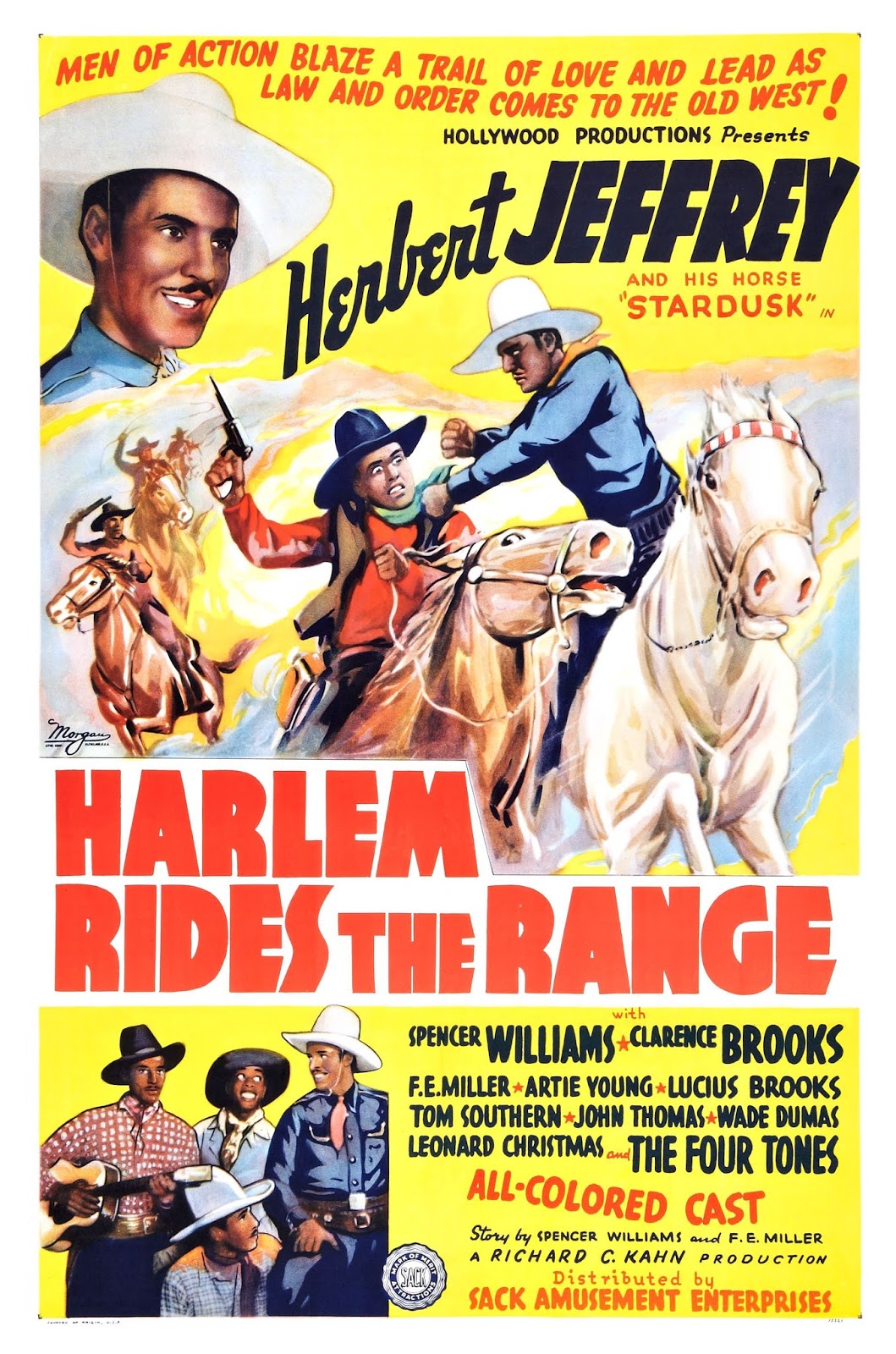
I really wanted to write about a black cowboy movie but thought I’d have to settle for one from the 70s or 80s. Then I came across this discovery: Herb Jeffries (AKA Herbert Jeffrey) was a singing cowboy from the 30s who starred in westerns with all-black casts.
He was very light-skinned (his mom was white) but identified as black. He started out as a singer in Detroit and moved to Chicago. In 1931 he joined Earl Hines’ band for a few years and then moved to LA in 1934. In time he became part of Duke Ellington’s band and lowered his vocal range to sound more like Bing Crosby.
While touring in the South with Hines, Jeffries experienced racism for the first time; the band could only play in tobacco warehouses and black-only theaters. When he saw black kids watching westerns, he decided they should have a black cowboy hero of their own.
He hooked up with producer Jed Buell, raised some money and wrote songs for the film. Jeffries had learned about horse riding on his grandfather’s farm, so he cast himself in the lead and used makeup to darken his skin.
Harlem on the Prairie was shot in five days in 1937 and though the critical reaction was mixed, it got a write-up in Time. “The Bronze Buckaroo” went on to make three more westerns, including the one I watched, Harlem Rides the Range, from 1939. I’m sorry to say it’s not very good; the acting is amateurish, the editing uninspired and there are only two songs in the hour-long movie.
That said, Jeffries was a good singer and the fact that his movies got made at all is an accomplishment in itself worth noting. He appeared in other non-western movies and television later in life, including an episode of The Virginian. A documentary short, A Colored Life, was made about him in 2008.