Friday, January 29, 2016

Anomalisa

Anomalisa
seen @ Kew Gardens Cinemas, Kew Gardens, Queens

In 1970, Professor Masahiro Mori, an expert in the field of robotics, theorized that as robots start to look more like humans, they'll become easier to empathize with. If one were to chart this progression on a graph, in which the x-axis represents human likeness and the y-axis equals familiarity, the points on the graph would form an ascending line. At a certain point, however, as the theory goes, a robot can look too human, and empathy quickly changes to revulsion. On the graph, there would be a dramatic descent in the line. When a robot's resemblance is no longer in sync with that of a human's, the line re-ascends. Eight years later, this concept was given the name "uncanny valley."

In animation, as technology has improved, especially with computers, the quest for making the perfect-looking human has escalated. Every year, movies and video games continue to push the boundaries when it comes to making more lifelike humans. In recent years, performance-capture technology has produced animated human characters of varying quality in films like The Polar Express, A Christmas Carol, and Beowulf.


Stop-motion animation is different. This is something I've talked about here before: somehow, at least for me, the most photo-realistic computer animation doesn't make me feel its "realness" more than stop-motion, probably because even the most photo-realistic computer animation still amounts to nothing more than illusions, phantasms. Stop-motion uses real materials that are manipulated in real space, not on a computer screen - and seeing real objects appear to move that don't normally move can be very unsettling, especially when you're looking at objects made to look as much like humans as possible.

This brings us to Anomalisa. The first time I saw the poster (that is, in real life and not on a computer screen), I was fooled into thinking it was a live-action movie, but then, I wasn't looking very closely. If I had, I would've noticed the seams running along the eye-line, across the bridge of the nose and up and down the sides of the face of David Thewlis' character Michael. Every "claymation" puppet in the film is like this, and as I watched it, I thought at first that perhaps it was a necessity in order to better animate the face. All I knew of this movie was what I saw in the trailer when I went to see Room. 


Without those seams, the characters look quite realistic - and maybe that's why they're there in the first place: to avoid the uncanny valley effect. (Once again, I'm writing this without having read about the movie, except for the one piece I happened to read last week, so my impressions will be fresher.) Even with those seams, they looked real enough, to a degree I don't think I've ever seen in a claymation picture before. I kept thinking the eyes, which people usually say are the dead giveaway as to whether animation looks real or not, must be CGI - and maybe they are. I'm not sure. The way light reflected off of them, plus the way they moved, couldn't be stop-motion like everything else, could it?

And then there's the puppet sex. I knew Anomalisa would have it, and I also knew that it wouldn't be treated like a joke, like in Team America, but I was utterly unprepared to see how far directors Charlie Kaufman and Duke Johnson were gonna go with it until I saw it unfold. (Spoiler alert: they go ALL THE WAY with it.) I found watching that scene unsettling. Part of it was the uncanny valley effect, but part of it was also the level of intimacy at work. It doesn't play like a sex scene in a typical Hollywood movie; there's uncertainty, shyness and a few false starts, yet I have to admit, as a scene, it worked.


So I guess now's a good time to talk about the story. Thewlis' character Michael is a corporate executive whose specialty is customer service (he wrote a book about it), and he has flown into Cincinnati to give a lecture before a group of retail/customer service employees, including Jennifer Jason Leigh's Lisa. Michael, a married man with a kid, looks up an old flame, but their conversation quickly turns sour. He gets depressed over roads not taken until he meets Lisa, with whom he has a pretty passionate one-night stand. Things look different the morning after, though, in more ways than one.

The film doesn't play out quite this simply. Every other character besides Michael and Lisa, looks similar, men and women both, and are all voiced by the same actor, Tom Noonan. This irritated me at first, until I understood why: it was meant to make Lisa stand out that much more. One thing Michael adores about Lisa when he first meets her is her voice, which is supplied by Leigh and not Noonan. Ironically, Lisa, while a nice girl, is not that extraordinary. She's introverted, almost painfully so; going about in the shadow of her more vivacious friend. She also has a scar on her temple that she hides with her hair and she's quite self-conscious about it. And then there are Michael's disturbing dreams...


Look closely at the faces of everyone surrounding Michael.

On a meta level, one can understand how even someone like Lisa can stand out in a world where everyone else literally looks and sounds similar. For Michael, she shines like a beacon in the dark, and he's ready to leave his wife and son for her, but then something changes. I won't reveal it here, partly to avoid spoilers, partly because it's difficult to describe. It's where the movie lost me.

Michael struck me as a dude going through a mid-life crisis, who needed Lisa to feel young again. She already idolized him, having read his book and come to hear him speak. She's not as demanding as his wife; in fact, she's practically putty in his hands. I wasn't completely convinced that what he felt was love, though we're meant to believe otherwise. I suspect the change that takes place might be as much his fault as anything else's. A conversation I heard in the bathroom afterwards would seem to confirm that, though I'm not sure.


Anomalisa isn't bad - the animation alone makes this a must-see - but given all the breathless raves for it, I expected something spectacular, and that's not what I ended up with. This is without a doubt one of those "see it again" movies, because there's clearly much more going on than meets the eye, and I'd be willing to do so. It just irks me that so many other people "got it" the first time and I didn't. Oh well.

P.S. If you're in the New York area, the Museum of the Moving Image currently has an Anomalisa exhibit running through next month.

Friday, January 22, 2016

Room (2015)

Room (2015)
seen @ Kew Gardens Cinemas, Kew Gardens, Queens

When I spent a little over a year in Columbus, Ohio, I lived in a tiny apartment in a rundown neighborhood with my friend Max. I must have met him sometime in the late 90s, when I was self-publishing comics and touring all over the country. Dude's a self-taught cartoonist.

I can't give you a sense of how small our place was based on words alone. It's not like I cared enough to try and measure it for myself, so you'll have to take my word for it when I say it was barely big enough for one person, much less two. There was a kitchen, a living room, a room that Max had been using for storage but most people, I suppose, would've used for a bedroom (he didn't even own a bed; I don't know why) and a bathroom, which was the only place one could get any privacy. All the other rooms led into each other, without any doors, so in a way, it was almost like living in a single room.

Wednesday, January 20, 2016

The File on Thelma Jordon

The Remembering Barbara Stanwyck Blogathon is exactly what it says on the tin, hosted by In the Good Old Days of Classic Hollywood. For a complete list of participating blogs, visit the link at the host site.

The File on Thelma Jordon (AKA Thelma Jordon)
YouTube viewing

It took me awhile to really get into The File on Thelma Jordon. For one thing, I was expecting a noir and it started out as a romance - and with a drunk man who was not that great looking to begin with. I would've thought Barbara Stanwyck had had better taste! In a nutshell, Stany's the prime suspect in a murder case, and her lover, Wendell Corey as an assistant district attorney, is the one who must prosecute her. The two of them also appear together in The Furies, from the same year, 1950.


She meets Corey under false pretenses, where he leads her to believe he's the DA when he's not. He's drunk out of his mind and tries to hit on her (he's married), even going so far as to chase her out of the building and to her car. But when he kisses her, wouldn't you know it, she kinda likes it a little. 

Stany's not riffing on Phyllis Dietrichson here; in her opening scene, she comes across as a fairly normal woman, so why she would find Corey anything but repulsive is beyond me. Still, once he sobers up the next day, he's not as bad, so I guess I could buy her giving him a second chance. Maybe.


I would've skipped the courtship between the two and started the film on the night of the murder, because that's when things start to get interesting. Corey thinks he can protect Stany, even when it comes time for the trial, but there's something he doesn't know that turns out to make all the difference in the world.

Stany's Thelma doesn't come across as your typical femme fatale anti-heroine at first. We slowly get hints that she may not be as innocent as she seems, but she doesn't quite come across as the type to commit murder, either. In movies like The Strange Love of Martha Ivers or Crime of Passion, we see her ambition, her willingness to manipulate her men into doing her bidding, but here it's the reverse. It's Corey who's pushing her to do this and that at every turn, especially on the night of the murder. I guess I'm just not used to seeing her in that kind of role.


I wish we could've seen more of this dog.

Thelma isn't bad overall, but it doesn't quite compare with those other Stany movies I mentioned. I liked Corey better in The Furies, where the creepiness of his character works for him. I didn't completely buy him as a leading man, and certainly not as one worthy of Stany.

----------------
All my Stany posts (so far!)
Baby Face
Night Nurse/Ladies They Talk About
Golden Boy
Sorry, Wrong Number
The Big Valley
Stella Dallas
The Lady Eve/Forty Guns
Barbara Stanwyck: The Miracle Woman (book review)
Banjo on My Knee/Remember the Night
Double Indemnity
Dynasty/The Colbys
My Reputation
The Furies
So Big!

Friday, January 15, 2016

Five ways to tell a SF/F story without a bad guy

Yes, I'm gonna bitch about The Force Awakens again, but only to make a bigger point. One of the biggest disappointments of the film for me was Adam Driver's character, Kylo Ren. As a villain, he didn't seem imposing and powerful enough to carry the film the way Darth Vader originally did in A New Hope, and because he came across like a third-rate Vader clone, his shtick felt old. (Just as an aside: Jen from my writing group agreed with me that TFA was a ripoff of A New Hope. She was pretty pleased that someone else thought the same thing as her!)

Did TFA even need a Big Bad? I realize this is Star Wars, and to not anticipate villains of some sort is probably the height of naivete, but one of my original hopes for this movie was for it to somehow distinguish itself from other modern genre movies, now that Star Wars is no longer the franchise everyone else looks to for innovation. Going without a central villain, even if only for one movie, could have shook up expectations in a big way, and could have even reexamined the way the Star Wars universe is perceived.

I reckon that most of the time now, sci-fi/fantasy movies are expected to have a primary antagonist of some sort. If it's a great, memorable villain, like Lord Voldemort or Agent Smith or Saruman, even better, but I'd like to see more mainstream films that buck this trend. Here are five kinds of general story tropes that can work perfectly fine without a bad guy, along with five examples of same.


- The rescue. It's often part of a typical genre movie, but rarely does it encompass the entire plot, and we don't have to look far for an example: last year's "musical comedy" (really, Golden Globes? Really?) The Martian. 

A rescue story may seem anti-climactic to a certain extent - who goes into one expecting the rescue attempt to fail? - but it's the "how" that's the exciting part: how the hero stays alive, how to extract him based on certain limitations and constraints. Bonus points if there's a time limit.

Part of the appeal of The Martian was seeing how Matt Damon survives, all alone, on Mars. It's a situation none of us could ever picture ourselves in, and yet the ingenuity and positive attitude of Damon's character made us want to watch him, to find out how much longer he could meet each new challenge and hold out until help arrived.


- The discovery. Discovering alien life would be a natural way to use this trope in genre movies, and Contact is a good example. One could argue that this movie has bad guys, but Tom Skerritt acts as more of a rival to Jodie Foster than an outright bad guy, and James Woods only appears for a small part of the movie.

A discovery movie challenges preconceived ideas about man and our place in the universe. We always thought things were x; now they're y. How do we deal with that? Contact provides answers by showing us the ground-level implications of the new fact of alien life, especially from a religious angle. Were aliens created in God's image too, and is that thought sacrilegious?


- The journey. From The Wizard of Oz to The Lord of the Rings trilogy, journeys, or quests, tend to have powerful antagonists that have a profound impact on the plot, but there are exceptions, and I would argue that The NeverEnding Story is one. The wolf Gmork is as helpless to prevent the destruction of Fantasia as anyone else, and while he presents a great challenge to be overcome, he doesn't factor into the story's climax the way a Big Bad like, say, the Wicked Witch of the West does. He's a villain, but not the villain.

I don't think I need to quote Joseph Campbell to get you to understand the appeal of a story with a journey. NES raises the stakes by having Atreyu's journey function as a story-within-a-story, and Bastian, the real-world child who's the film's true protagonist, travels with Atreyu in a literal sense as well as a metaphorical one, as we discover towards the climax. It's a mind-bender of a movie which works on more than one level.


- The search. In this case, I don't mean searching for someone to be rescued, but a search for anyone or anything vital to the plot. All three stories in Darren Aronofsky's The Fountain involve searches of one kind or another, without a prime antagonist.

The search could involve going on a journey, or a discovery could be made during the search (none of these story types are mutually exclusive to each other), but the point is that somebody needs to find something or someone, or else.

The Tree of Life of legend links all three tales in The Fountain. Hugh Jackman, as three characters across three time periods, looks for it, uses it to find a cure for his dying wife, and takes it with him to search for a new home in space. Maybe you liked the way Aronofsky pulled it off, maybe you didn't (assuming you even saw it). Personally, I liked it.


- The romance. A love story of some kind is often supplemental to a genre adventure of some sort, but rarely is it the raison d'etre. Eternal Sunshine of the Spotless Mind is an excellent case study, in which the sci-fi elements support an unusual romance.

The nice thing about a SF/F romance is that it's not reliant on alien settings or different time periods. In fact, telling such a story in the "real world," or something very close to it, has the potential to attract a bigger audience, one which might not normally watch a genre movie.

In Sunshine, Jim Carrey and Kate Winslet have their memories of each other erased by a business that specializes in this practice, yet in Carrey's case, he can't quite let go of his memories of Winslet. It's a bittersweet love story that speaks to the experiences of anyone who has loved and lost, and the sci-fi elements make it stand out from the vast majority of romances that have explored similar territory.

Thoughts?

-------------------
Related:
"Nothing ever ends."

Thursday, January 14, 2016

Oscar 2015: The nominees

For Best Picture:

The Big Short
Bridge of Spies
Brooklyn
Mad Max: Fury Road
The Martian
The Revenant
Room
Spotlight

The rest.

Last year, as you know, was devoted to classic movies around these parts, and as part of my immersion into this field (though, in hindsight, I doubt this was all that necessary), I chose to sit out the Oscar race. As a result, many more movies flew under my radar this year than usual. 

So seeing this year's Best Picture nominees comes as a pretty big surprise for once. I knew Bridge of Spies and The Martian would probably get in, but certain movies that seemed like sure things on paper, like Steve Jobs or Joy, didn't make it in - and what do we have instead? Three small indie movies, two - TWO! - sci-fi movies, and what I'm assuming is a horror film - but more on that in a second.

I think we're finally seeing a switch from traditional "Oscar bait" movies. If so, then it's about time. I'm seeing a whole lot of new names amongst the major categories, and the absence of other names - Spielberg and Scott and Zemeckis and Boyle from directing, Hanks and Bullock and Smith from acting, and Tarantino and Sorkin from the screenplay fields - is telling.

I'm very happy for Brooklyn going all the way. I figured Carol would be the one to get the Best Pic nod instead, but at least Blanchett and Mara both got nominated. One thing I failed to mention about 45 Years was the acting, which was quite good, so seeing Charlotte Rampling's name up there is also gratifying. Sly Stallone for Supporting Actor? I know he just won the Golden Globe, so I suppose anything's possible. The Force Awakens getting an editing nod? Interesting. Didn't see that coming. Ditto for Ex Machina and Straight Outta Compton for Original Screenplay. Pretty good year for SF, in fact. I am disappointed that Inside Out didn't have enough juice for Best Pic. I really thought it had a chance there.

Okay. About The Revenant. Yesterday, I was convinced I would not see this movie. I had absolutely no interest in seeing Leonardo DiCaprio get raped by a bear, and frankly, I couldn't understand why anyone would make a movie like this, based on what I've read, which, I admit, isn't that much.

Leo looks like a sure thing for Best Actor at this point, and if so, then good for him. He's certainly deserved it for a very long time, and I think it's fantastic that he continues to take chances with his roles. He's no longer the pretty boy from Titanic; he's become this generation's greatest actor. Plus, Alejandro Inarritu directing back-to-back Best Pic winners would be an amazing feat.

I just don't know if I wanna see this movie. Call me a wuss if you want.

Anybody wanna try convincing me?

-----------------
Related:
2014 nominees
2013 nominees
2012 nominees
2011 nominees
2010 nominees

Wednesday, January 13, 2016

45 Years

45 Years
seen @ Lincoln Plaza Cinemas, New York

Seeing 45 Years was kind of a spur-of-the-moment decision. All the movies I had wanted to see at the time (Joy, The Hateful Eight, Concussion) had gotten mediocre reviews, and I was kind of itching to see something new after coming off a year of blogging about old movies. I had noticed that this flick had gotten incredible reviews - one compared it favorably with Mike Leigh's Another Year, which I liked a lot - and Vija was planning to see it as part of our movie club, so I figured why not.

I can't say I know a great deal about Charlotte Rampling. I know she was an actress from the 60s and 70s that had been in some art house stuff, like The Night Porter. I recall seeing her name pop up in more recent indie movies. I don't know how big she is in relation to other British actresses like Vanessa Redgrave or Judi Dench or Maggie Smith.


Rampling and Tom Courtenay are a married couple about to celebrate their 45th wedding anniversary with a big party. A week before the party, though, he receives new information about a long-dead lover of his from his youth, and it gets him thinking about her again - maybe a bit too much, to Rampling's way of thinking. Tension starts to settle between the couple, but then she makes a discovery about her hubby's old flame that really turns the screws.

If it sounds like I'm having a hard time mustering enthusiasm for this film, it's because I am. First of all, the comparison to Another Year isn't entirely accurate because in that one, the conflict was external to the starring couple, whereas here it's totally internal. Plus, 45 Years is more serious. (I forget in what context the comparison was made.)

I dunno, maybe I just didn't have the patience for such a talky movie this time. Normally, I can deal with talkiness if it's in service to an interesting story, but I couldn't get into this one. I don't even think it's a bad movie; it just didn't do anything for me. I didn't understand why Rampling didn't act on the discovery she makes at the halfway point. While I believe Courtenay did still love his wife, he tended to be mostly cranky toward her and maybe even a little senile. Well, except for when they try to have sex. (You don't see anything.) 


The reviews make this movie out as this great romantic love story, but I didn't quite buy it. Another Year had romance. I totally believed the relationship between Jim Broadbent and Ruth Sheen, and while I knew it wasn't all rosy, I felt more invested in it and them. Even a movie like Amour, depressing as that was, had more palpable emotion for me. Maybe I need to watch 45 Years again. It's subtler than those other two movies, that's for sure, but I don't feel the need to do so.

I saw it with Vija, Franz and Lynn, and I don't think any of us were bowled over by the movie. I think Lynn might've liked it the most, but she had to leave early afterwards so I couldn't find out for sure. Franz outright hated it, and the virulence of his displeasure - leavened as it was with his usual eccentric humor - made it feel strange to be more or less in alignment with him, if not total agreement. On the plus side, at least this movie cost less than Brooklyn.

Monday, January 11, 2016

Carol

Carol
seen @ Kew Gardens Cinemas, Kew Gardens, Queens

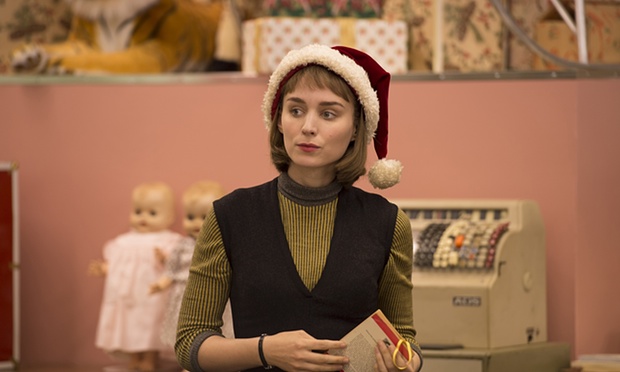
There's a scene in the movie Carol where Rooney Mara's character questions whether it's possible for her to love another woman despite not having any homosexual inclinations. She feels herself falling for Cate Blanchett's Carol, and though she doesn't completely understand it, she's willing to go along with the feeling. She leads a pretty normal life. There's a dude who's got the hots for her; even wants to marry her. So why can't she seal the deal with him? What makes Carol different?

Director Todd Haynes, to his credit, doesn't try to give a definitive answer other than this: sometimes you just can't help loving who you love. It could be a married person. It could be someone much older or younger. It could be someone of the same sex. Doesn't matter. Whether you can follow through on that feeling, well, that's something separate - and of course, it depends on whether the other person feels the same way about you.


I didn't expect to get as caught up emotionally by Carol as I was; I had thought this to be similar to Haynes' Far From Heaven, which was also set in the 50s, but the two are nothing alike. The latter is clearly meant to evoke a vintage filmmaking style, in both looks and in the storyline. Carol is much less melodramatic. I don't think it's a spoiler to reveal that Blanchett and Mara's relationship is consummated eventually - and boy, is it ever! - but it comes at a point where you know it has to happen, where it would be wrong if it never happened. That's powerful stuff.


Could I fall for a dude - out of the blue, with no warning? I've thought about what it would be like to be gay. I've even joked about it. The truth is, though, for that to have any chance of happening, the dude would have to be one in a million at the very least. Even then, would I have the courage of acting on those feelings? I strongly suspect not - and maybe that's a failing of mine. I dunno.


Human sexuality has been redefined and redefined again so much within my lifetime - and yes, there are those who would say that none of what we're seeing now is anything new - and I have to admit, to someone like me, it's a little scary. I don't entirely understand why certain people have certain tendencies. I try to keep an open mind about it all, I really do, but it's not easy. The notion of sexuality being fluid goes against many of the things I had grown up believing.

And yet you do kinda buy it after seeing the characters in Carol. Mara falling for Blanchett makes sense and it doesn't at the same time, but you wanna believe in it, you wanna believe that one could be capable of pursuing feelings that go against what one considers the norm. Maybe it is... and maybe some of us will get to experience that once in our lives before we die. But I suspect most of us won't.