Wednesday, December 30, 2015

New release roundup for December '15


- Brooklyn. Delightful little movie. I knew Saoirse Ronan was destined for greatness from the first time I saw her, in Atonement, and it looks like she's finally achieved stardom with this film.

I saw it with Vija and Lynn (not my sister; different Lynn) at the City Cinemas on the east side of Manhattan, a nice theater that I hadn't been to in years. Turns out it's gotten an upgrade: reclining seats that you can pick out yourself at the box office, just like AMC. Unlike AMC, however, they have the nerve to charge a whopping 18 BUCKS for the privilege. Yes, sports fans, 18 bucks (though they do have a half price matinee before noon). I tried to get in as a senior, but it didn't work - the clerk asked for ID! (If only I hadn't have shaved...)


replica of Ronan's outfit on display at the City Cinema
I don't think Vija and Lynn ever tried to reserve seats at a movie before; they had a bit of a hard time interpreting where the seats were based on the floorplan on the computer screen. We ended up getting seats near the back of the auditorium, but Lynn, a much older woman, didn't fancy the thought of going up all the stairs, so Vija and I tried to exchange our seats. Lynn, however, gave Vija her receipt instead of her ticket and she couldn't find her ticket, so we sat in a row further down, hoping that no one that reserved these seats would come and kick us out. So of course, that's exactly what happened. Twice. And then there was the adventure involved when the two of them attempted to recline their seats... It's a good thing we were able to laugh about it all in the end.

If Brooklyn wasn't such an excellent movie, I would've regretted paying so much for it, but I'm certainly not likely to go back to City Cinemas unless it's for a $9 matinee - which is possible, I suppose. Anything for a bargain...


- Spotlight. I almost slept on this one (not literally). I remember reading about it a few weeks ago and I thought, yeah, I'll check this one out, but it came out sooner than I had realized, so by the time I was reminded of it, I was afraid it would leave the theaters. Not likely; it's gotten great reviews and will probably be an Oscar contender - and rightly so. I remember when the news about Catholic priests molesting children first became a hot topic, but I wasn't aware how the story broke. This movie tells that story, and it's done very well. It doesn't let the Boston Globe reporters off the hook for failing to pursue the story further the first time around, but it goes to great lengths to show them doggedly chasing the facts, as they realize this is a bigger story than they initially realized. Riveting material.


*          *          *

That's it for 2015! Before I ride off into the sunset, I gotta send out some thank you's: thanks to Danny from Pre-Code.com and Fritzi from Movies Silently for their help with the banners; Maria Ramos for her Ray Bradbury piece; Jacqueline for giving me such a great interview - check out the blog devoted to her book Ann Blyth: Actress Singer Star, where she has additional Ann Blyth material, plus news on signings and appearances, all that good stuff; thanks to ClassicBecky for being my partner in crime for the CinemaScope Blogathon; Le for letting me put her in my Black Orpheus post, and also for recommending The Given Word (excellent movie); Paddy for her Liebster Award, for all her recommendations, all her retweets, and for being such a good friend... and thanks to you for reading.

I'll return on Wednesday, January 6, 2016 with The One Year Switch Postgame Show before we return to the original format of old and new movies. Happy new year!

Monday, December 28, 2015

Citizen Kane

Citizen Kane
from my DVD collection

They say you can't take it with you - when you die, that is (whoever "they" are; there's always some "they" saying something) - and that's one cliche that happens to be true. Ours is a materialistic culture. We like having things and we like ascribing a value to them, whether real or imagined. Sometimes, though, we get carried away with them. Sometimes things matter more than they should.

You all know I come from a background in comics, not just as a collector and a creator but as a journalist. I first became a comics columnist in 2000, and acquiring comics, particularly self-published and other independent ones, was important to me, not only for personal enjoyment, but also so I could write about them. One never knows where the next Walking Dead or Fun Home will come from, after all.

At some point along the way, though, I think I may have gotten my priorities screwed up.


Wednesday, December 23, 2015

Star Wars: The Force Awakens

Star Wars: The Force Awakens
seen @ Movieworld, Douglaston, Queens, NY

SPOILERS

I don't know why I never got into Star Wars as a kid. (Just so we're on the same page: when I say "Star Wars," I'm referring to the franchise in general; when I say "A New Hope," I'm talking about the original 1977 film. And TFA, of course, stands for "The Force Awakens." Got it?) You hear and read so many stories about people who grew up with a Millennium Falcon model or stood in line for Empire on opening day with their older sibling or met the dude who played Alien #6 in the Mos Eisley cantina at their local sci-fi con and got his autograph or whatever, but that stuff never happened to me - and given what Star Wars has become, it strikes me as a little surprising now.

Could it have had anything to do with my older sister? Back then, I tended to look to Lynne for cues on what was cool, and I don't remember her talking a great deal about A New Hope or Empire when they came out. She certainly never had any of the merchandise. I do recall her telling me about Jedi when it was released. She described the Ewoks, thinking I'd like them. I think she even had that stupid Ewok song on 45!


Anyway, I saw Jedi, and I enjoyed it, but I don't think I had any sense of it as the cultural phenomenon it had become to that point - not that it would've mattered. I don't remember talking to my friends about it. We talked about other pop culture stuff. Baseball, yes. Pop music, television, comics, definitely, but Star Wars? Not really. It almost feels like a betrayal of my generation to admit how late I got into the game, because it's so deeply ingrained into our mythology, our identity.

But what can I say? I dreamed of playing right field for the Mets, not of flying an X-wing fighter. I never felt like I was missing out.

Monday, December 21, 2015

Top 5 movie-going moments of 2015


I almost wasn't going to do a Top 5 this year, because I honestly didn't think I had enough to round one out - but then I realized that not every positive movie-going experience has to include something odd or unusual, though this list includes those too. Once again, I was fortunate to have seen some world-class films on the big screen, on celluloid, and those should be acknowledged too. So here you go:


5. Pather Panchali @ Film Forum. I wish I could've seen the rest of the Apu Trilogy at the Forum as well, but I can hardly complain about getting to see the first film in the series, on a big screen. It was as good as I remembered it.

4. Lawrence of Arabia in 70mm at MOMI. It wasn't the greatest movie I've ever seen, but seeing it on a big screen in 70mm was worth the trip - and it certainly increased my appreciation for seeing films on celluloid. Seeing it with an appreciative crowd always helps.


3. Son of the Sheik with the Alloy Orchestra at Celebrate Brooklyn. One thing I never mentioned about that summer night in Prospect Park is that after the movie, I happened to run into my old girlfriend as I was about to leave the ampitheater. It was totally unexpected; I didn't think she had any interest in old movies in general, much less silent movies, but she was there with a friend of hers, talking to some other people, and she was pleasantly surprised to see me, to say the least. The three of us hung out at a nearby bar afterward. It was the first time I had ever bought her a drink - strange experience, that. I had never seen her imbibe before. But it was a nice way to end a terrific evening.


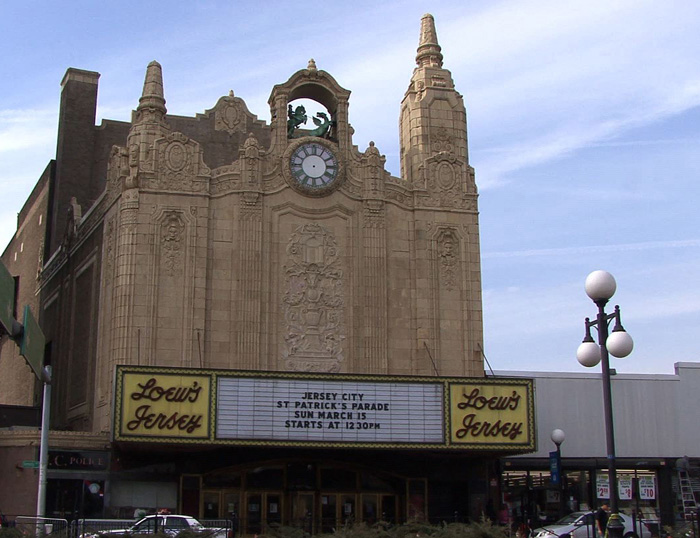
2. Being at the Loew's Jersey City the night FOL won their court case. This is perhaps a bit of a cheat: being there was actually kind of anti-climactic given that I had found out the news while I was still in Hoboken, earlier in the day - but it was part of that thrilling eight hours or so where I was constantly on my cellphone, searching for news articles and updating my blog as I learned more about the story. It was fun to act like a real journalist for that day, especially when it involved a story I cared about. And even if this wasn't an "exclusive," at least I got video footage (however grainy) of the announcement at the theater, so there's that. Without a doubt one of the best moments in the history of this blog.


1. First-run movies returning to Forest Hills' Cinemart with American Sniper. If you saw my supplemental Tumblr blog, you might remember when I wrote about this from wa-a-a-a-a-y back in January: the Cinemart Fiveplex in Forest Hills, a second-run theater for years, resumed showing first-run movies with the release of American Sniper, and in so doing, gave their 90-year-old cinema a shot in the arm. It was quite exciting, in a small-scale way, to have been part of the festivities, and naturally, I'm pleased to see a neighborhood theater continue to thrive amidst the multiplex chains. I went back there this month to see Spotlight, and they look like they're still doing well.


------------------------
Previously:
2014 top five
2013 top five
2012 top five
2011 top five

Friday, December 18, 2015

Louis B. Mayer

Metro-Goldwyn-Mayer, back in the day, boasted that they had "more stars than there are in heaven," and they weren't far from wrong. More than any other studio from the Old Hollywood era, perhaps, MGM epitomized the glamour and the spectacle of American movies, and the crafting of stars was a huge part of their success.

There's a quote attributed to MGM head Louis B. Mayer - the second "M" in "MGM" - that I find quite illuminating:
The idea of a star being born is bush-wah. A star is made, created; carefully and cold-bloodedly built up from nothing, from nobody. All I ever looked for was face. If someone looked good to me, I'd have him tested. If a person looked good on film, if he photographed well, we could do the rest. . . . We hired geniuses at make-up, hair dressing, surgeons to slice away a bulge here and there, rubbers to rub away the blubber, clothes designers, lighting experts, coaches for everything—fencing, dancing, walking, talking, sitting and spitting.
We've always been obsessed with stars, for various reasons. For some of us, like myself, it's about talent, the ability a certain actor has to immerse him- or herself in a character and make us believe this fictitious person is real, with a life and a worldview and a personality that exists beyond the borders of the movie screen. When I see Barbara Stanwyck stand up to someone, it's thrilling for me because the force of her personality informs the character she inhabits in a way that's exciting, that makes her seem powerful. When Jack Lemmon stumbles embarrassingly through a conversation, I find it endearing because he comes across like an ordinary guy, with the same kinds of hangups as anybody else, even when he does things that are selfish and unwise. 

At the same time, however, there are some stars whom I just love to look at on a big screen, no explanation necessary - and I think that's what lies at the heart of what made the MGM star system under Mayer such a success.


MGM was formed in 1924 as the merger of three different production houses by businessman Marcus Loew, including Louis B. Mayer Pictures. Mayer became head of the studio, with his number two man from Mayer Pictures, Irving Thalberg, as vice president in charge of production.

Going back to Mayer's quote at the top: I'm reminded of what I once said about Greta Garbo, one of MGM's biggest stars - that her appeal rested largely with her on-screen persona, her mesmerizing face. I had said that I didn't think she was that outstanding an actress, but it didn't matter because of her presence, the way she came across in front of the camera.

Her story makes for a good example of how Mayer and Thalberg created stars. The Swedish Garbo had studied acting in Stockholm, and Mayer had seen her in a film while he was in Berlin (though some accounts say he saw the film before coming to Berlin). Supposedly, he took one look at her, and based on her eyes, was convinced he could make a star out of her. In 1925, Garbo came out to Hollywood and Thalberg gave her a screen test, which she passed with flying colors. Garbo's look was shaped and refined, and she was given roles that crafted her as an exotic woman of the world. She didn't like it much in the beginning, but it turned her into a superstar. It sounds like the cliche story of stardom, but even cliches have a basis in fact.

History records that Mayer had a tendency to try and control an actor's off-screen life as well, like a surrogate father, only with an eye towards protecting their reps as stars, and therefore, his investment in them. Some MGM stars, like Joan Crawford, were okay with this, while others, like Elizabeth Taylor, weren't. 


I doubt I would like such meddling, however well-intentioned. To me it sounds like going beyond the bounds of what a proper business relationship should be. Doing things like signing morality clauses in their contracts hardly prevented some actors from behaving badly, anyway. I can understand the motivation behind the meddling, but I think it's asking too much to expect other human beings to behave the way you want them to. It's no wonder that stars at other studios, like Bette Davis and Olivia de Havilland, sued to get out of their contracts.

Oh, by the way, did you know that Mayer co-created the Oscars as a way to prevent actors and filmmakers from unionizing? I can't really say I'm surprised - it was, after all, one more means to control the careers of his stars. It's so easy to forget sometimes why they call it show business.

Thalberg died suddenly in 1936, but Mayer was able to soldier on, even through the World War 2 years. After the war, though, times got tight for the studio, and eventually Mayer stepped down as head in 1951. He died of leukemia six years later. While the industry today is less reliant on star power than it once was, many of the MGM stars from the Golden Age that we continue to revere today became who they were, in part, because of Mayer.


---------------------
Previously:
Jack Lemmon   Jean Arthur   Edward G. Robinson
Rita Moreno   Frank Capra   Bernard Herrmann
Fred Astaire   Cecil B. DeMille

Wednesday, December 16, 2015

Laugh, Clown, Laugh

Laugh, Clown, Laugh
TCM viewing

Loretta Young was without question one of the all-time great beauties of the silver screen, in an industry not exactly lacking in great beauties. An Oscar winner for the film The Farmer's Daughter, she also had a long-running, multiple Emmy-winning television show that is still remembered fondly. Seeing her in the silent film Laugh, Clown, Laugh at the tender age of 14, I was mesmerized not only at her breathtaking looks, but at what was a remarkable and deeply sympathetic performance opposite Lon Chaney Sr., who must have been three times her age, at least! I was reminded of the first time I saw Natalie Portman, at about the same age, in Beautiful Girls. I was eager to learn more about Young after watching the movie, and boy, did I ever...

...though it wasn't exactly what I expected. I don't know how I missed this story from earlier this year, but according to her son, daughter-in-law and biographer, Young may have been raped by none other than Clark Gable and had a daughter by him. If you don't know about it, I urge you to check out the story at that link; it's long but well worth the read.


One obviously hopes, for Young's sake, this allegation isn't true - she, Gable, and her daughter are no longer around to confirm or deny it - but perhaps the saddest part is how Young was unable, like many women in similar positions over the years, to say anything. It's a familiar story, told again and again whenever there's a man in a position of power and privilege who feels entitled to take what he wants without fear of consequence. And that's all I got to say about that.

On the surface, Clown seems like a spiritual sequel, or at least a spin-off, to Chaney's other clown movie, He Who Gets Slapped, and while this also ends on a sad note, it's a little less dark. Chaney is a clown who performs with his partner throughout the towns and villages in Italy. One day he finds an abandoned child and adopts her. She grows up and becomes part of the act as a tightrope walker. Chaney finds himself attracted to her, but is way too embarrassed about it to say anything. The situation is exacerbated when he meets a count who also falls for his ward.


Chaney had some serious comedic chops. He puts on a slapstick clinic in which even Chaplin could've taken a lesson or two. One wonders if Chaney could've reinvented himself as a funnyman within the sound era had he lived longer. In Slapped, his clown character's humor has an undercurrent of tragedy that taints his performances. That's not the case here; at least, not at first. There's an early scene where he tries to make Young's character as a baby smile. It's reminiscent of Chaplin in The Kid, and just as endearing.

Young plays Simonetta as a teen and a young adult, and though it's a little squirm-inducing at first to see her kiss a grown man like a woman, I don't think it comes across as exploitative or prurient. Chances are it still wouldn't go over well if this had been made today, despite how heavily sexualized teens and even pre-teens already are in the media. Once again, context matters. This isn't a Lolita situation; Chaney's Tito recognizes Simonetta as a grown-up woman and that's when his feelings for her change, even though he still can't express them. Young's performance changes as well; she comes across as more mature, in a subtle way.


Chaney was way more than just a master of disguise; he was a legitimately good dramatic actor who knew how to convey subtlety of emotion in a medium without the advantage of sound. While we'll never know if he could've sustained his career in the sound era, part of me is kinda glad he belongs to the silent era (yes, I know he made one talkie). He didn't need to be heard to make his presence felt.


Monday, December 14, 2015

The Bingo Long Traveling All-Stars and Motor Kings

The Bingo Long Traveling All-Stars and Motor Kings
YouTube viewing

So did you watch the World Series this year? The Mets were in it, so naturally, I was eager to see them beat Kansas City, but even though our boys lost, I have to admit, there was drama and excitement aplenty throughout all five games. 

So why do I keep seeing this myth being perpetuated over and over about how baseball is losing popularity, especially with the youth? Yes, I know the arguments: other sports are supposedly more exciting to watch; declining TV ratings, the rise of fantasy baseball as a viable alternative; aging fan base, etc., and there are those who continue to advocate in favor of baseball's popularity.

I don't deny that my interest in the game waned for a time. For me, it was the 1994 cancellation of the World Series that did it for me. For awhile, the only games I watched were minor league ones. Yes, even here in New York City, we have minor league teams, one in Brooklyn and another out on Long Island. I've also been to minor league games in Massachusetts and Ohio. 


I couldn't really stay away from the allure of the majors, however. Baseball is too much a part of my DNA. It's too closely associated with memories of my father, memories of childhood friends, growing up so close to Shea Stadium I could walk there - all of that still means something to me, and I always thought baseball would continue to have meaning for plenty of other people too. 

Still, let's play devil's advocate and assume the sport is on the decline. Could the reason why be a matter of baseball lacking a little... pizzazz? Yes, there are mascots and exploding scoreboards and pop music playing over the PA, but all of that is separate from the action on the field. In basketball, you can slam dunk the ball. In football, players would occasionally dance in the end zone after a touchdown, but if you try that now, they give you a penalty. Baseball? Well, I fondly remember the curtain calls the Mets would give after home runs, but I didn't see any of that during the World Series.


There used to be a time when a little razzle-dazzle in baseball was not so unusual. The Bingo Long Traveling All-Stars and Motor Kings is a fun little movie about the days of the Negro Leagues, where a little showboating went a long way in terms of entertainment. Lando Calrissian and Darth Vader lead a team of Negro League stars who want to get out from under the thumb of their penny-pinching owners by barnstorming around the country, making money for themselves. When the owners find out, though, they do their best to try and put the kibosh on the rogue players' success. Richard Pryor is in this, too, and though he has a few moments, he's not quite as funny as he would be in later films, where he was the star.

The All-Stars learn that to attract crowds to their games, they have to put on a show, so they wind up doing things like parading in the streets of the town they're visiting, dancing and strutting; playing on-field pranks during the game; dressing up in the occasional costume or two, and playing with an exaggerated hustle and flair. It's something they were familiar with before: in the beginning, we see Billy Dee Williams pitch to James Earl Jones, the first batter of a game, daring him to hit his pitch as the rest of his team watches from the sideline. As a team, though, they take it to a new level, one that attracts black and white audiences alike. Imagine the Harlem Globetrotters if they were a baseball team.


Can modern baseball learn something from this? Baseball used to be heavily resistant to change for a long time, but in watching the Series this year, I was amazed to see the changes the game has implemented now: the use of instant replay, six umpires instead of four (though I think that's only for the playoffs), so many players looking like they came out of the 70s, what with their long hair and beards. Still, can you imagine showboating on a league-wide scale, if it means baseball becoming popular again? 

I'm not even sure if that's what I'm advocating. All I know is that fans love slam dunks and end-zone dances. As a kid, I loved seeing Darryl Strawberry and Gary Carter give curtain calls - and needless to say, this kind of stuff makes for good television, too. I think there may have been a backlash against this sort of thing because sometimes it made for hurt feelings on the other team's side, but you know what? They're professionals. They should be able to deal with it without resorting to retaliation at the offending player. No one did that in Bingo Long - but then, that movie represents a time when the game was very different indeed.