Tuesday, September 13, 2011

Kinyarwanda: a primer

Director Alrick Brown
 

...After earning his master’s from Tisch, Brown continued making shorts while consulting for other filmmakers. One of those people was Ishmael Ntihabose, a Rwandan filmmaker who was trying to make a feature about the 1994 genocide that occurred in his country. “We were e-mailing back and forth through a Peace Corps contact for several years,” says Brown,” “and when I got there I realized Ishmael needed a lot more than just consulting to pull this off.”

These videos and links can speak about the film way better than I can, since I haven't even seen it yet. It'll be the closing night film at the Urbanworld Film Festival this weekend, on Saturday night at 7:30 at the AMC 34th Street in Manhattan.

-------------------------

Related:

Monday, September 12, 2011

Five reasons why 'Potter' probably won't get a Best Pic nom

I feel it's important to address this now while the Oscar season is still young. I know y'all want it to happen. You saw Avatar, Inception and District 9 get nominated in a ten-film field, you've been breaking out all the comparisons between Deathly Hallows 2 and Return of the King - the money-making final chapter of a series of acclaimed films based on a line of fantasy novels beloved the world over - and you really, really love Harry Potter and want to see him finally make it to the big Oscar dance party (even though eight films and billions of dollars worldwide means he's had a pretty good dance party of his own going on for awhile).

I wouldn't completely rule it out... but the odds do not look good on it happening. And here's why:


- No precedent for a Best Picture nomination. Everybody comparing DH2 to King is forgetting something: yes, King got a Best Picture nomination, but so did Fellowship of the Ring and The Two Towers. In a ten-film field, Deathly Hallows 1 did not make the Best Picture cut, and anybody who thinks that DH2 can get in on sentiment is fooling himself. And don't bring up Toy Story 3 because animated films come with their own set of rules that don't apply here.

- No precedent for a Best Director nomination. Sasha Stone from Awards Daily always says that the director is the star of the Best Picture race. The Potter films have had four different directors in eight films. The Lord of the Rings films had just one - Peter Jackson. So when King won Best Picture, it was as much an affirmation of Jackson's singular vision guiding the entire series as it was a reflection of their quality. Jackson was nominated for Best Director for both King and Fellowship, winning for the former. Give David Yates credit for being the ironman for the final four Potter films, but neither he nor any of the other Potter directors were serious enough contenders for Best Director. And in a field this year that includes Spielberg, Eastwood, Malick, Daldry, Payne, Reitman, Crowe, and Allen, Yates will be lucky to get into the conversation.

- No precedent for any acting nominations. This one is key. Ian McKellen got nominated for Fellowship. That right there is one more acting nomination than any Potter actor has received. If there's any area that DH2 needs support in, this is it. Actors make up the single largest voting bloc in the Academy by a ratio of greater than three to one, and over the course of seven prior films, not one Potter actor has gotten nominated. And it's not like the cast is full of Joe Shmoes: you've got Ralph Fiennes, Alan Rickman, Helena Bonham Carter, the late Richard Harris, Emma Thompson - I mean, these are some heavyweights here. If these guys couldn't get nominated after seven films, why would they get nominated now?

- Sometimes money isn't enough. The Dark Knight made over half a billion dollars and got near-universal praise and you saw what happened there. Avatar made money and did get into the Best Picture field, but James Cameron had already been to the party before, with an epic drama without any aliens, superheroes or wizards. And as we have learned, the director is the star of the Best Picture race. The Potter films have made an insane amount of money over the years, but the most it has been able to come up with Oscar-wise is only technical nominations. (As an aside: I think Christopher Nolan is at a comparable point in his career as Cameron was after Terminator 2: an innovative director who makes crowd-pleasing, critically-acclaimed genre work that gets little love from the Academy. If The Dark Knight Rises gets nominated for Best Picture next year, make no mistake, it'll be because the Academy decides that it's finally Nolan's time, but if not, then he may have to make a Titanic, or to use an example from a different director, a Benjamin Button. Of course, I say "have to" facetiously; Nolan will do as he will and I doubt he cares that much about the Oscars anyway.)


- The competition is stiff. Warners alone has Clint's J. Edgar, along with Extremely Loud and Incredibly Close, two huge films that will be in the mix for almost every major category. Warners may start a Best Picture campaign for DH2 as well, but when you also add films like Midnight in Paris, The Tree of Life, The Help, The Descendants, The Artist, The Girl With the Dragon Tattoo, The Ides of March, Tinker Tailor Soldier Spy, War Horse - well, you can see how this will get mighty crowded. And don't forget that a ten-film field is not guaranteed this year.


Like I said, I would not completely rule out DH2 from the running, but I just don't see any way Harry pulls off this magic trick unless some of the competition falls by the wayside somehow.


Agree? Disagree?

Saturday, September 10, 2011

WSW @ Urbanworld FF 9/15 - 9/17!

I didn't want to make an official announcement until I was sure I had gotten in, but I just saw my confirmation e-mail this morning. Next week I will attend the Urbanworld Film Festival here in New York! This is pretty exciting, because I've never been to a film festival before. The closest thing to one I've been to was the 24-hour sci-fi marathon in Columbus, and that, as you might imagine, was entirely informal. The Urbanworld lineup looks quite interesting; among the films showing includes Kinyarwanda, the second film distributed by AFFRM.

As a result of me founding out about this now, I've completely rearranged my schedule for the next few weeks. The Concert Movie Week is canceled (maybe I'll do it another time). This Tuesday's editorial will be moved up to Monday so that I can write a preview of Kinyarwanda on Tuesday. On Thursday I'll preview the rest of the films I'm (tentatively) planning on seeing, and then the rest of the week will be devoted to the fest (no Soundtrack Saturday next week).

Soundtrack Saturday: Madonna


Good singer, great performer, so-so actress. Early word on her second movie as a director, W.E., is not great. Be careful what kind of flowers you give her.

"Into the Groove" from Desperately Seeking Susan

"Sooner or Later I Always Get My Man" from Dick Tracy


"This Used to Be My Playground" from A League of Their Own

Friday, September 9, 2011

World in Film

The World in Film Blogathon is an event in which the goal is to list seven films representing the seven continents of the world, hosted by the site The Great Movie project. For a complete list of the participating blogs, visit the host site.

I decided to put a twist on this idea, since naming seven movies from seven continents would be a little too easy. Six of my seven movies feature indigenous people in some fashion. The seventh is Antarctica, and honestly, how many people do you know who were born there?


North America
Atanarjuat AKA The Fast Runner
I actually saw this when it came out and was deeply moved by it. This is a tale of Inuit people in the Canadian Arctic area (so this might be a little bit of a cheat). The Inuit have been more commonly known for years as Eskimos, but don't call them that because they don't like it. They hunt native animals like whales, polar bears and seals, they get around on kayaks and dog sleds, and use mostly animal skins, driftwood and bones to make things.


South America
At Play in the Fields of the Lord

Never saw this one, but it's set in the Amazon rainforest and revolves around a fictitious tribe of natives and the white missionaries there to convert them. One real tribe that resides in the rainforest, however, is the Awa, or Guaja. In the 19th century, they became nomads in order to escape Europeans who cleared their lands. In 1982 the Brazilian government took out a loan from the World Bank and the EU to set aside land for them, but they wouldn't get around to doing it until 2003.


Africa
The Gods Must Be Crazy
The natives in this comedy are Kalahari Bushmen, also known as the San. The Dave Matthews Band recorded a song inspired by the music of the San called "Eh Hee." Listen to Matthews describe his meeting with the San and then hear the song itself, which is pretty kick-ass.

Europe
Vacas
Okay, I don't know much about this one, but IMDB says it takes place in the Basque part of Spain in the late 19th and early 20th centuries, and the Basque are one of Europe's oldest indigenous races. The film begins around the period of the Carlist Wars, a series of civil wars within Spain in which the Basques supported Carlos V and his heirs.


Asia
The Tartars
This Orson Welles flick sounds like it's about the Volga Tartars (or Tatars),  to be more specific. Tartars started out living in the northeast Gobi Desert, until they moved south in the ninth century, and west later on. Many inhabited Europe as well as Russia. Fun fact: Charles Bronson is of Tartar ancestry!


Australia
Walkabout
David Gulpilil's Aboriginal character in this film is probably Yolngu, since Gulpilil himself is of that group. Why do Aussie Aboriginal males do a walkabout? It's a rite of passage meant to re-connect them with their ancestors and the things they did. Gulpilil got the part in the film due to his great skill as a tribal dancer, which got the attention of director Nicolas Roeg. He went on to become a star in his country, appearing in a number of other films, including Baz Luhrmann's recent Australia.

Antarctica
Happy Feet
Well, they are native to Antarctica.

Wednesday, September 7, 2011

Support Your Local Sheriff

Support Your Local Sheriff
seen online via YouTube
9.6.11

I've yet to talk at length about Westerns. My father loved them, of course, whether on TV, with shows like Bonanza and The Big Valley, or films. I can't recall if he had a favorite Western star or not; he seemed to like a wide variety of Western movies. not that I would know for sure; as a kid, I used to think the genre was corny, so I never paid it much mind. I do know that he tended to prefer the standard Golden Age Hollywood fare. I don't recall ever seeing him watch any spaghetti Westerns (though I'm sure he must've seen Clint Eastwood on TV in Rawhide) or any Western after the 60s, but it's been so long.


We know now that the classic Hollywood image of the Wild West was mostly myth - that between the slaughtering of Indians, the unsanitary living conditions, and the casual brutality that leads to gunfights, it probably was not a fun time to be living in. But it was a Western, after all, that taught us that when the legend becomes fact, print the legend. Westerns are so intrinsically American - so tied to the idea of this country being a place that any (white) man can conquer and make his own as long as he has the will and the strength of character to do so - that even today, long after Westerns have declined in popularity from its heyday, their hold, however tenuous, remains.


Blazing Saddles remains, for me, the gold standard in Western comedies, but I would put Support Your Local Sheriff not too far behind. I found out about it from the delightful blog Thrilling Days of Yesteryear and had it on my schedule for a few months before an opening came up this week. James Garner plays the familiar archetype of the stranger who arrives to clean up the one-horse town, but he's no stoic lone wolf like Eastwood (who, oddly enough, ventured into the lighter side of the Western in the same year with the musical Paint Your Wagon). He becomes town sheriff only because he needs the money, and his plan is to eventually leave for Australia, of all places. He's gotta take on the local bad men first, though, not to mention woo the token love interest. It's a slight story, but a fun one. I liked it.

Tuesday, September 6, 2011

Does Lucas have the right to alter 'Star Wars'?

...The more permanent and physical the perception of an art form is, the more it is perceived by the public as “art” rather than mere entertainment. A good example of this is sculpture and painting. Paintings are hung in galleries and museums. They are preserved from disintegration and frequently restored to prime condition. These practices are seen as culturally valuable to the point where allowing a painting to be defaced or lost to time is considered practically criminal. That’s wonderful, but then why do we allow so many films to languish and to be treated without the respect they deserve? Why do we accept George Lucas altering his classic films and then refusing to make the original versions available to the public, sometimes going as far as to claim that the original negatives have actually been destroyed in the process of creating the Special Editions? Why do we allow this?
I'm not as huge a Star Wars fan as others, but of course I enjoy the movies to a degree (I've written about the first time I saw Jedi, for example). George Lucas' constant fiddling with the movies, especially the original trilogy, is something I've certainly found odd, but I've never given it a great deal of thought, especially not from his perspective - until now. The occasion of the Blu-ray release of all six films, complete with even more cosmetic alterations, has caused fan outrage to swell once again, but I want to take a moment to try to see things Lucas' way.

I went on Facebook and asked some of my artist friends (painters, photographers and musicians, specifically), framing the question in general terms, whether an artist has a right to go back and alter his or her work after it has been appraised by the viewing public. The opinions were split. For some, the need to preserve the original work was an absolute; new technology can lead to new interpretations of older work but the originals should not be suppressed. Others thought the rights of the creator were paramount; public opinion should not get in the way of staying true to one's vision as long as the work belongs to the creator.
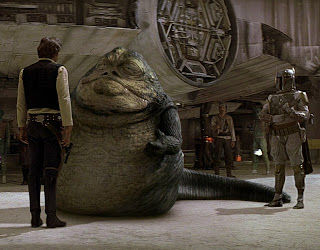
Do I think Lucas should let it go and learn to live with his films as they are? Yeah, but clearly he can't, hence the question I pose: is this a bad thing? Lucas is obviously uncomfortable with the version of the films that we've been familiar with for generations. As the creator, he wants his work to be the best it can be. If he feels that it isn't, and if he has the power to do something about it, isn't that his prerogative as an artist? We may prefer the original versions, but we had no hand in their creation. We did not commission these movies; we did not pay Lucas to make the Star Wars films; he made them on his own. And through the unique deal he struck with 20th Century Fox, he owns them. Its status as a cherished pop culture landmark does not change that fact.

Perhaps it's the kinds of alterations that fans object to? If Lucas went back and made more favorable changes to the fans, would we still have this conversation? But then, if he does that, he's compromising his work in order to kowtow to his audience, and that sets a bad precedent. Audience feedback is necessary for further artistic growth, but one should be careful not to heed it too much - and frankly, a part of me feels uncomfortable with the idea that fans can be so influential as to interfere with an artist's creative process.

I completely understand and sympathize with the fans' objections, and I'm even inclined to say that they're not wrong, but at the same time, I know how it feels to want to go back to a work of art and tweak it a bit after it's been released to the public. Rare is the artist who is completely satisfied with a "finished" work, and while I do believe Lucas needs to move on, I find I don't have the right to judge him if he's honestly unsatisfied with the original Star Wars movies. By the same token, however, if the fans are unsatisfied with the revised versions, then they absolutely should not buy them. It goes both ways.

I'm willing to concede that I could be wrong, however, so I'm eager to hear other opinions on this.

---------------
Related: