This is Barbara Stan-week! All this week we'll celebrate the life and career of my favorite actress, Barbara Stanwyck, covering different eras of her long and distinguished journey through the Golden Age of Hollywood.
Sorry, Wrong Number
seen online via YouTube
8.10.11
There's this video on YouTube that compiles a bunch of moments in horror movies when the cell phone stops working for whatever reason. It's interesting to see how often it happens, because cellphones have made instant communication easier than ever - which can be a hindrance when you're writing a movie about a group of teenagers being stalked by a psycho killer. I mean, how long a movie would Halloween have been if Jamie Lee Curtis could have had the cops come down on Michael Myers with just one call, even if she was away from a land line?
Being stalked over the phone is a horror movie staple going at least as far back as Black Christmas. What I've never understood, though, is why the victim continues to stay on the line and listen to the killer rant and threaten. It's so silly! If it were me, I would've hung up long ago, but they continue to listen and to get more and more scared, and the next thing you know, boom - the killer's in the house and coming up behind them. I think one of the Scream movies made fun of this.
Sorry, Wrong Number isn't a horror movie, but the ever-mounting sense of dread the bed-ridden Barbara Stanwyck feels as a result of the telephone is palpable. While making a call, the operator accidentally connects her to a different line in which she hears two people plotting a murder. Through the series of subsequent calls she makes and receives, she learns that her missing husband may be connected to it in some way, but she can't even leave her bedroom because she has some mystery ailment. And then she figures out who the intended murder victim is and things get real in a hurry...

I didn't like the first two-thirds of the movie. The editing wasn't smooth, the music was over-the-top and I wasn't feeling a great deal of sympathy for Stanwyck's character (in flashbacks we see that she was a scheming, man-stealing bitch). But then a funny thing happened. Something about the way she played her - the state of utter hysteria she's in when the reality of her situation becomes more and more apparent - turned me right around and suddenly I wanted to know what would happen to her. And the ending just knocked me out. I could not believe it ended the way it did, but it did!
Number was Stanwyck's fourth Best Actress Oscar nomination, and while I might have thought her shrill at first, like I said, somewhere along the way she made me feel for her, which I didn't expect. And while this may not be the best film noir I've ever seen, it has its moments, especially in the cinematography. You'll see Stanwyck for instance, alone in her bedroom on the phone, and the camera will slowly move around the room, taking in everything, and then it'll move out and down the hall, all while Stanwyck is still talking on the phone. There's more than one scene like that, and it provides a nice sense of isolation. Still, it's the final fifteen minutes or so that definitely save this movie.
----------------------
Previously in Barbara Stan-week:
Night Nurse/Ladies They Talk About
Golden Boy
This is Barbara Stan-week! All this week we'll celebrate the life and career of my favorite actress, Barbara Stanwyck, covering different eras of her long and distinguished journey through the Golden Age of Hollywood.
Golden Boy
seen online via YouTube
8.9.11
The story of the great friendship between Barbara Stanwyck and William Holden is one of the sweetest in all of Hollywood, and I was pleased to learn about it while preparing for this week, since Holden is another one of my favorite actors. The short version is that Golden Boy was one of Holden's very first movies, and his inexperience showed initially. Stanwyck saw something in him, though, and fought to keep him in the key role of the young boxer torn between prize-fighting and pursuing his dream of being a violinist. Her hunch paid off, and Holden would continue to get steady work in the movies - and then, of course, Sunset Boulevard made him a superstar. He never forgot the way Stanwyck stood up for him, though, and every year he'd send her flowers on the anniversary of Golden Boy's release, April 1. And when Stanwyck received an honorary Oscar in 1982, she remembered her old friend, who had died the year before.
The movie itself is quite powerful. It's based on a play by Clifford Odets, and the dialogue in places feels quite flowery and theatrical. Odets, a former actor, co-founded the theater company called the Group Theater, and as a result had ties with guys like Lee Strasberg, Sanford Meisner and Elia Kazan, whom I've talked about before. I wouldn't call Golden Boy a Method movie, though.
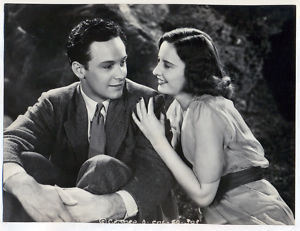
In Stanwyck's scenes with Holden, one can see pretty clearly the traces of the actor he would become, but at the same time he has a vulnerability that perhaps is the product of his youth (I didn't even recognize him at first). They have a good rapport with each other, which one can see even in the scenes where they quarrel. Stanwyck had been in the game for over a decade at this point, having already made movies with directors such as William Wellman, King Vidor and Frank Capra, and had gotten the first of what would be her four Best Actress Oscar nominations (for Stella Dallas), so for her to be able to see something in Holden seems reasonable to me.
It's also worth mentioning that Golden Boy came out in the extraordinary year of 1939, regarded by many as perhaps the greatest year in movie history: the year of Gone With the Wind, The Wizard of Oz, Mr. Smith Goes to Washington, Stagecoach, and many more. What was it about that year? Who knows? Maybe the stars aligned just right for Hollywood.
----------------------
Previously in Barbara Stan-week:
Night Nurse/Ladies They Talk About
Leonard Maltin hopes not:
...I’m not a fan of toilet humor—which in this case actually involves gags about people using the toilet and/or talking about their bodily functions. That’s just the tip of the iceberg: [The Change-Up] seems positively eager to break down supposed barriers and wallow in foul-mouthed, crude behavior and dialogue... Because the film is enjoyable at times, I have to wonder how much (if anything) would have been lost if it had been toned down a bit. Would audiences have complained that it wasn’t edgy enough? Might it have suffered in comparison to other recent hit comedies?
But maybe some movies need to be raunchy:
...This may sound juvenile, and yes, I'm well aware that comedy can be derived from any number of sources more innocuous than gratuitous sexual content, explicit language, drug use, and violence, but certain comedies don't feel genuine without the risk factor. Crude comedies and black comedies, the kinds that pull their subjects from the dark pits of human suffering and certain deadly sins, should push at their confines without worrying about catering to someone's definition of what's appropriate. Sometimes this may lead to failure (I'm looking at you, Hangover II), but when 'going there' pays off, it pays off big.
I'm a Kevin Smith fan, so you better believe I appreciate dick and fart jokes as much as the next guy. R-rated comedy definitely has its place at the multiplex. So why hasn't it done anything for me lately? I dunno. I suppose if I were to see The Hangover, I'd laugh. Perhaps not as much as other people, but I'm sure I would. Still, I never felt the desire to rush right out and see it or any other comedy like it from the past several years. I've never seen a Judd Apatow movie, I gave up on Adam Sandler long ago, and I've never seen a Ryan Reynolds movie since he became a star (apparently he was in the first Harold and Kumar movie).
I can't explain it. A trailer for a comedy either appeals to me or it doesn't. If Clerks were to come out this week, would I go see it? Depends. A big part of what has defined Smith as a filmmaker is his independent, DIY aesthetic. That has shaped my perception of him. If Clerks were a studio film and Smith was being touted as the new Judd Apatow, that'd be a huge difference in how I saw him, so perhaps he's not the best example. My original point still stands, though.
But are raunchy comedies the only ones that hit big? I looked up the top 20 money-makers from the years 2006-10, as ranked by Box Office Mojo. 19 out of those 100 movies were comedies in the broadest sense of the word, including musicals like Mamma Mia and action comedies like Get Smart. 17 of those 19 comedies were either PG-13 or R. The PG-13 movies include stuff like Little Fockers, Grown-Ups and Rush Hour 3, not exactly highbrow material. Here's the key stat, though: of the four R movies, look at the upward trend in terms of (domestic) money made:
- Borat (2006), $128 million
- Knocked Up (2007), $148 million
- Sex and the City (2008), $152 million
- The Hangover (2009), $277 million
And of course this year, both The Hangover Part 2 and Bridesmaids have surpassed $150 million.
The Maltin quote at the top was from his review of The Change-Up, which he did find funny in places, despite his misgivings on the level of vulgarity. He followed that up a couple of days later with another piece further expanding his feelings on raunchy comedy, and his feelings on the matter echo my own:
...I don’t believe that everybody embraces The New Vulgarity, but no one wants to be the naysayer—or prude—who voices objections when friends find something funny. The box-office success of movies like The Hangover changed the playing field for what is widely considered “the norm,” and that’s what worries me. We’re expected to accept a much higher level of raunchiness than moviegoers did just a few years ago…and I don’t think there’s any turning back.
I like to think certain comedy classics like Some Like It Hot would be successful today, but our standards have changed from fifty years ago. I accept that. But dick and fart jokes only amuse me for so long.
Agree? Disagree? I'd really like to know.
This is Barbara Stan-week! All this week we'll celebrate the life and career of my favorite actress, Barbara Stanwyck, covering different eras of her long and distinguished journey through the Golden Age of Hollywood.
Night Nurse
Ladies They Talk About
seen @ Film Forum, New York, NY
7.19.11
It was probably Double Indemnity that did it for me. I'm not sure whether I first saw it in my film history class in college or while working at the old video store I worked at, but either way, it was likely that film that made me admire Barbara Stanwyck. My reaction to the movie was on a similar level to when I saw Sunset Boulevard for the first time (both Billy Wilder films; not a coincidence): I've never seen anything like this before. From the way she talked, the way she moved, the way she acted, I believed that Stanwyck was a woman that a man would kill for.
Then I saw more of her movies, and I saw other sides to her; how she could be playful, virtuous, treacherous, elegant, and more. She wasn't a va-va-VOOM sex goddess like Marilyn or Rita, but she could easily evoke sensuality. She didn't challenge gender roles in the same manner as Katherine or Joan, but she was tough enough to stand up for what was hers, no matter which side of the tracks her characters came from. She made mediocre films good and good films better - and she'll forever be remembered as one of Hollywood's greatest leading ladies.

Night Nurse and Ladies They Talk About were two movies shown during the Film Forum's marvelous recent series on pre-Code Hollywood. (When I saw it, it was part of a triple bill which also included the William Powell film Lawyer Man, which was also good.) Stanwyck's career began in a time when movies, still in its infancy, were castigated by conservative organizations for their alleged immorality. In 1930, a production code was adopted that was designed to restrain what could and could not be shown in the movies, but it wasn't until 1934 that it was given teeth. One of the pivotal films that ultimately led to enforcement of the Code was Stanwyck's own Baby Face.
In Night Nurse, Stanwyck and Joan Blondell are nurses at a hospital, and Stanwyck discovers a plot by a delinquent mother to kill her daughters and collect on their trust funds. In Ladies They Talk About, Stanwyck, for her part in a series of robberies, goes to prison thanks to an old flame turned radio evangelist, who she still has a thing for. I liked Nurse better. It's got a mixture of drama and comedy, it's sexier (I think the sight of Stanwyck and Blondell in their slips must've been what offended the prudes back then), plus it's got an early appearance by a mustache-less Clark Gable as a bad guy! Ladies didn't quite live up to the promise of seeing Stanwyck in a women's prison movie - the prison wasn't anywhere near as rough as I thought it might be, and the ending seemed like a cop out.

I've found pre-Code films to be somewhat of a mixed bag. Some of them do live up to their reputation, but others have struck me as more pedestrian. Of course, I understand that social mores were very different back in the late 20s and early 30s, and I try to keep that in mind when I watch them, though it's not easy. One of the first movie books I ever bought was an anthology called Movie Censorship and American Culture, a group of essays detailing the history of the film industry's long battle against censorship. The Code period gets a great deal of discussion, naturally, so I'm familiar with the context of the time period in which films like Nurse and Ladies were part of. Given the pressures Hollywood was under to kowtow to conservative groups, perhaps the very fact that they were able to make the movies they did is significant of itself.
(Dig this: I just discovered that today marks the 80th anniversary of Night Nurse's release! I totally did not know this and did not plan for it. It's a complete coincidence.)
Metropolis
last seen @ Celebrate Brooklyn, Prospect Park Bandshell, Brooklyn NY
8.4.11
As often as I hang out in Brooklyn, I don't go to Prospect Park that often, though I try to whenever I can. It's a wonderful park, with all sorts of attractions in and around it - Grand Army Plaza, the library, the museum and the botanical gardens are all within its vicinity; the Bandshell and the Zoo are among its major highlights, and downtown Brooklyn is only minutes away. Since I never grew up in Brooklyn or went to school there, though, I guess it's never been as special to me as Central Park. Still, it's one of the best places to go to in all of New York.
In the past few years, Prospect Park has become notable for other things. On the west side of the park, radiating out from Grand Army Plaza and overlooking Park Slope, the city's transportation department recently installed a two-way bike lane, protected by parked cars. I've ridden it. It's a beautiful stretch of real estate that not only has attracted numerous bikers from throughout the region, but by taking out a single lane of traffic (and a few parking spaces), it has significantly slowed down traffic on this one-way street, making it safer to cross and reducing the number of accidents. Sounds awesome, right?

Depends on who you ask. The city is currently dealing with a lawsuit brought against it by a small group of affluent, politically-connected Park Slope residents who are absolutely convinced that not only is the bike lane unnecessary, but that the city lied about how safe it is. Unfortunately, their suit fails to take into account certain irrefutable facts, such as that the local community board requested this bike lane, and that the Department of Transportation was completely upfront about how it measured the lane's safety.
This may seem like a story of local interest only, but it actually has much wider implications. For one thing, it has gotten international attention - the UK newspaper The Guardian has written about the bike lane battle. More importantly, with federal and state support for public transportation being questionable at best, more people have re-discovered biking, and many cities around the country have taken steps to re-orient their streets to accommodate its resurgence in popularity, New York included. The degree to which these changes are accepted by the greater populace, many of whom not only drive cars, but subscribe to the poisonous mentality that that cars are king - a mentality that has led to numerous unnecessary, preventable deaths - will determine the future of transportation in America.

But none of this changes the beauty of Prospect Park itself, or its propensity for hosting exciting events, like last night's screening of the restored version of Metropolis. Celebrate Brooklyn is an annual, summer-long series of outdoor shows and performances held at the Prospect Park Bandshell. It's usually concerts featuring musicians from around the world as well as local ones (I saw The Swell Season here), but they also show old movies here (earlier this summer they had a West Side Story sing-along night).
The Bandshell is a lovely outdoor venue that includes concession stands with beer and affordable gourmet food, though I brought a hero sandwich and chips with me. Those who don't sit in the seating area in the front camp out on the grassy knoll towards the back. I brought a blanket with me, expecting to do the same, but to my surprise, I made it early enough that I could sit up front. There was an opening act before the movie; a local cellist named Marika Hughes, along with her band. They were alright.

Metropolis was scored live by a remarkable three-man band called the Alloy Orchestra, who make a very good living at scoring silent films and have played at Celebrate Brooklyn for many years. In a fortuitous bit of timing, Raquelle from Out of the Past just posted an interview with a silent film composer, Jeff Rapsis, who talks about how one composes music for silent films. In this interview, he mentions how he'll cobble together certain melodies for certain characters and scenes while watching a film on his own first, and then expand on those melodies improvisationally when it's time to perform live. I kept that in mind last night, and indeed, there were certain key melodies repeated at important intervals.
I wish I could convey to you how exciting AO's score was. It ran the gamut from bombastic to gentle, stately and solemn to funky and danceable, and it enhanced the movie to a degree unlike anything I'd seen or heard before. If these guys come to your town to score a silent movie, make sure you go see them! I've said it before, and I'll say it again: it's one thing to see a movie on a computer or television monitor, but it's another thing altogether to see it on a great big screen with an enthusiastic crowd. I feel like I hadn't really seen it until last night - and not just because of the restored footage. This too, was one of the best movie experiences of the year so far for me.
The Captains
seen @ The Intrepid Sea, Air and Space Museum, New York NY
7.30.11
Believing in a better world has become harder and harder. I have no doubt that people in all eras of history have thought this at one time or another, but the downward spiral we've all been on really does seem like it has gotten deeper... and yet the dream represented by Star Trek lives on. Trek is a multi-million-dollar pop culture franchise, of course, but if you look past all the toys and T-shirts and novels and video games and other tchotchkes, at its heart it remains a story of what could happen if the people of the world put down their guns and their bombs, forsook greed and hate, and started to work together. If that idea sounds too hippy-dippy and romantic to you, well, have you picked up a newspaper lately?
My relationship with Trek has become a little distant lately, I admit. For one thing, the books have taken a darker turn, which has sapped more than a little of the fun out of reading for me, so I've dropped them for the moment. Maintaining this blog has kept me from watching old episodes as often as I have in the past. And I never was much of a Trek con-goer. Still, I'm always game for an excuse to renew my ties to Trek, and last Saturday I got to do that in a big way by seeing William Shatner's new film The Captains on board the USS Intrepid.

Shatner, of course, has been the most recognizable face of Trek for decades. The very name "Captain Kirk" has become a metaphor for so many things - hammy acting and nailing alien space babes being the least of them. The character is an icon not just of television, but the 60s in general. He embodies the hopes and dreams of John F. Kennedy when he invited America to be pioneers in his New Frontier. And if Shatner portrayed him with an excess of brio, then that, too, can be interpreted as part of the spirit of the times, which were turbulent and violent, but also passionate and creative.
Of course, Shatner's story does not begin and end with Trek; far from it. Indeed, it is astonishing to see how he has reinvented himself over and over through the years, from his subsequent television roles to his books and spoken-word albums and commercials and more. His ability to not only cultivate a unique public image but to make fun of that image from time to time has endeared him to newer generations of fans, and should not be underestimated.

Still, it is Trek which remains his greatest legacy, and in The Captains, he discusses that legacy with his successors in the captain's chair: Patrick Stewart, Avery Brooks, Kate Mulgrew, Scott Bakula, and the newest member of the club, Chris Pine. As a director, Shatner is, of course, best known for the fiasco that was Star Trek V: The Final Frontier. Here, at least, he doesn't have to worry about sub-par special effects or a ridiculous script, although I did find the editing heavy-handed and the score a bit treacly at times. (It should be noted that Shatner has directed a second movie this year, William Shatner's Gonzo Ballet, about the making of the ballet based on his last album Has Been.)
At its heart, The Captains is about acting. We, the audience, don't get to see how truly difficult television acting can be - the long hours on the set, the challenge (in this particular case) of wrapping one's tongue around complex and near-incomprehensible technobabble (Mulgrew likened it to mastering Shakespeare), the toll it takes on one's outside relationships. Shatner and his fellow thespians discuss all this and more here, and it's extremely enlightening. They have more in common than just Trek: most of them are theater-trained, some are equally adept musicians (Brooks spends most of his interview time in front of a piano), and all of them faced unique pressures in building and expanding this franchise, and some of the stories they share will genuinely surprise you.
I don't love all of Trek equally; there are some incarnations I favor over others. Still, to see all of those incarnations represented by their stars, in a film devoted to the history and meaning of Trek, was quite thrilling for me...
...as was the venue in which I saw it. I had never been on board the Intrepid before. It's a World War 2 aircraft carrier docked on the west side of Manhattan in the Hudson River, which hosts a museum devoted to military history and scientific endeavors. Normally it's expensive as hell to visit, but the Captains screening was free. (They show other free movies during the summer, but this was not part of that series.)
As you can imagine, the line to get in was huge and filled with Trekkies galore. I waited on line next to a hard-core fan who was there with his sister and a friend. He was dressed in a red Next Generation uniform with a rubber Klingon forehead and a wide variety of replica weapons and other props from both the Original Series and Next Gen eras. His sister and friend were more casual fans. I remember hearing his sister saying she preferred Shatner in Boston Legal. Though his costume wasn't that elaborate, the guy got photographed by lots of people and even got a brief interview with a camera crew from Epix, which hosted the event (you'll recall they also hosted the Warriors screening).

Fans were invited to dress up as part of a pre-show costume contest, but regrettably, there were few costumes more elaborate than Spock ears and a Starfleet uniform. The best costume by far was by this one girl who created a replica of the Enterprise-D (with glowing lights) which she wore on her head. Her outfit was black with white dots, and her face was painted the same way, to represent space no doubt. As you can imagine, she was the biggest hit.
The screening was held on the top deck of the Intrepid, where the jet planes were kept. I briefly got to look at them. There was even a Blackbird, which was smaller than I imagined. They didn't provide seats, though, so everyone had to sit on the deck itself, which wasn't so bad, I guess. I lucked out with a great spot; dead center, near the front, amidst a huge crowd of people. Among the pre-show music were selections from Shatner's upcoming album.
Oh, and did I mention that the director and star himself was present too? He addressed the crowd from a stairway leading to the navigation bridge with cameras surrounding him from below. He made a point of how personal The Captains is to him, and in watching it, this does come through. The other actors became his good friends through the making of the film, and he even gained new insights into his relationship with Trek.
All in all, it was an extraordinary night, one of the best movie-going experiences I've ever had.
----------------------
Related:
Star Trek (2009)
Star Trek Into Darkness
Star Trek: The Motion Picture
Star Trek TNG: The Best of Both Worlds
Mixtape movies: The Trek captains volume


