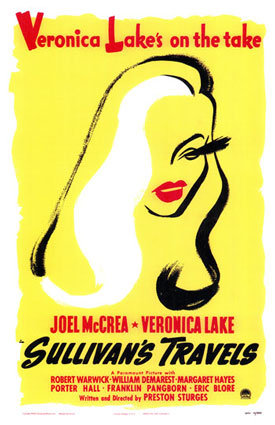
 Sullivan's Travels
from my DVD collection
12.7.10
A successful filmmaker, known for directing popular films light on substance, goes out into the world beyond Hollywood in search of experience that will inform his next movie, which will educate as well as entertain. Am I talking about John L. Sullivan... or James Cameron?
I think one could make an argument for the latter. As I watched Sullivan's Travels last night, I couldn't help but think of Cameron and Avatar. True, Cameron didn't really start pounding the pro-environment drum until after the movie was released, but he is making two more films in the series, and he's sort of become Mr. Save The Earth lately. Consider: he joined with a bunch of indigenous Brazilian tribes to help save the rain forest, he met with the EPA on ways to stop the BP oil spill, he spoke before the United Nations, he has promoted NASA, and he wants to plant a million trees. And while I suspect (hope) Cameron really does feel he's doing some good in the world, at the same time it's not hard to imagine that all of these acts will help him gain a deeper perspective on his fictional world of Pandora when it comes time to write the screenplay for the Avatar sequel.
Joel McCrea's character Sullivan, lik e Cameron, sees the injustice and suffering in the world and believes he can use his movies to make a difference. Sullivan feels he needs to climb down from his ivory tower and interact with the "common man" to do it. Ultimately, though, he concludes that he had it all wrong: that using his movies to make people smile and laugh, especially during a time of economic hardship, can be a noble end in itself.
Well, here we are, once again in a time of economic hardship, but what have the most popular movies of the past couple of years been? Fantasies. Transformers, The Dark Knight, Harry Potter, Twilight, Star Trek, Inception, the Pixar movies, and yes, Avatar, all dealing in make-believe worlds far removed from our own. So maybe Cameron gets to have his cake and eat it too in a way Sullivan doesn't - after all, Sullivan abandons his dream project by movie's end. (Although it still got made, kind of.)
I realize Sullivan's Travels is meant to be a comedy, but I find I'm a bit disappointed that Sullivan wasn't able to find a way to combine both his sense of social justice with his flair for entertainment. While I can see the value of escapist entertainment during hard times - be it comedy or fantasy - I've always treasured those works of art that have something to say about the world we live in as well, if not more so. In the case of films, I think they tend to go down easier when they're dressed up in fiction - hence Avatar's success. Personally, I would hope for more movies that have such aspirations. Am I wrong?
 Wow, who was it who just said that separating the artist from the art is essential? Gotta love the timing on this one.
Well, I still believe in that statement, but let's be honest - it's not easy. It's not easy at all to appraise the work of a creative person who says or does things that are reprehensible to you, and I have my blind spots that I probably should work at overcoming. That said, I still believe it's the work that matters in the end. Why? Because as creative people, we like to believe that our work will outlive us. Even if the artist is forgotten, the work - if it's good enough - can have a life of its own and can influence future generations. And that's the most we can hope for in this life.
What do we know about The Beaver? The screenplay by Kyle Killen topped the 2008 "Black List" of unproduced screenplays, meaning it was highly sought after. Both Steve Carell and Jim Carrey were attached to the film before Mel Gibson came on board. Insiders on the film tried to stir up some Oscar buzz for Gibson on the belief that The Beaver might be released late this year. And perhaps most notably, director and co-star Jodie Foster, a long-time friend of Gibson's, continues to stand by him.
The trailer itself is intriguing in terms of not only Gibson's performance, but the art-imitating-life factor (especially when Foster's character says "I will continue to fight for you"). It looks like it might have a substantial element of sap running through it as well, though from what I've read from those who have read the screenplay, that's not the case.
Right now, my feeling is that I think I may give it a shot, though more on the basis of Foster's reputation and the much-buzzed-about screenplay than Gibson himself. I think Foster's continued support of Gibson is remarkable and should not be minimized; indeed, I think it's her presence that could mean the difference in how well The Beaver does. I'd be very interested in hearing what other people think about this.
The Beaver (trailer)
Also:
- Danny Boyle says Trainspotting 2: Electric Boogaloo is only a matter of time. (Cinematical)
- An interview with Mark Logue, grandson of Lionel Logue, Geoffrey Rush's character in The King's Speech. (Speakeasy)
- Speaking of The King's Speech, has a whispering campaign against it already begun? (Scott Feinberg)
- It's hard out here for a black director. (NPR)
- The facts and the fiction behind Peter Weir's new film The Way Back. (BBC)
- How the MPAA regards the sex in Blue Valentine versus the sex in Black Swan. (LATimes)
- Leonard Maltin talks about the Disney/Dali collaboration Destino. (Movie Crazy)
 The Large Association of Movie Blogs (LAMB) is, as the name suggests, an online collective of movie bloggers which Yours Truly has joined as of this writing. Whether you're a fellow LAMB or someone who reads LAMB blogs, thanks for stopping by. I never realized how much I had to learn about blogging until I started following the LAMB and its affiliate blogs, so I hope WSW will be a better blog as a result.
 This is a unique circumstance. Last Tuesday (November 30th), Andrea invited me to an advance screening of the forthcoming Steve Martin film The Big Year. I like Steve Martin as much as the next guy, but one has to admit that it's been awhile since he's made anything that matches with his classic comedies. Still, he's surrounded by an awesome cast in this movie: Jack Black, Owen Wilson, Brian Dennehy, Dianne Wiest, Anjelica Huston, and Kevin Pollak, to name but a few. I figured it'd be worth a look for free. Therefore, this will be more of an actual review than my usual posts. (The on-set picture below is from the site The Frat Pack.)
The Big Year is based on a non-fiction book about competitive bird watching over the course of a single year. The film version must be a fictionalized version inspired by the actual events, then, since the names of the three primary characters were changed. I certainly didn't realize the movie was based on a true story, and I doubt Andrea did either. Not that it made a difference.
We saw the movie in a screening room at the Crosby Street Hotel in SoHo. According to the invite, the doors would open at seven and the show would start at eight. We took our time getting down there, even though the weather wasn't the greatest that day (Andrea likes long walks at least as much as I do, if not more). There was a line outside the hotel and we got on it, only to hear from others on the line that there were no more seats! We asked the two women in front of us if this was true; they weren't sure, because they'd arrived earlier and were told to come back later.
So some dude came outside and the two women addressed him, because they were naturally pretty upset. Andrea, whom, I've learned in the short time I've known her, is quite a quick thinker when the situation calls for it, stepped in and helped argue their case as if all four of us were together, and sure enough, the dude moved all four of us to the front of the line, though he didn't let us in yet. So we talked among ourselves a bit while we were waiting, and eventually the guy came back and led us inside. (Don't ask me what happened with the other people in line. The only reason I suspect this even worked is that those two women said they'd been told to come back later and Andrea made him think we were with them. Like I said, quick thinker.)So eventually we got  to see the movie, after some more waiting. It's not terrible, but I didn't find it particularly funny either. A movie like this, with a big cast and a comedic touch, needed a Christopher-Guest-mockumentary approach. Indeed, the more I think about it, the more I wish Guest had made this movie instead. He would've made much better use of the comedic talents on display here. Kevin Pollak is in this movie and he's not funny! That should never happen. Huston has the best of the secondary roles, playing the skipper of a ship who has a grudge against Wilson's character, and while she gets some good mileage out of the role, even she doesn't come alive as much as she should.
The most impressive stuff in The Big Year, I thought, was the location shots and the bird-related material. There's one brief moment where we see two eagles mating in mid-air, which is a breathtaking sight, but I suspect it and similar bird shots were taken from stock footage and not made specifically for this movie. In fairness, we were told that this was still a work in progress.
The movie isn't silly enough. There are times where I felt it wants to be, but it doesn't go for that level of comedy. It's very middle-of-the-road. Maybe that's because this was inspired by a true story; I dunno. But when you've got comedic actors on the level of Martin, a living legend, and Black, who can be playful and wacky in the right role, you really need to let them do their thing. I wish I'd thought to write all this in the survey cards they gave us after the movie. I mostly wrote about the location shots and Anjelica Huston.
The Big Year should come out sometime next year. I suppose fans of the book will like it more than I did. Has anybody out there read the book? If it's good, maybe I'll read it.
 Soundtrack of the week: Clerks
I should probably write a post about the movie too at some point, because of how much it means to me. But I can't forget about the soundtrack.
Love Among Freaks, "Berserker"
Song-about-movies of the week: "Bela Lugosi's Dead"
All nine and a half minutes of it!
Song-that-would-make-a-good-movie of the week: "Iron Man"
Only THIS time it would be the way Black Sabbath originally intended. Per Wikipedia: "The lyrics tell the story of a man who time travels into the future of the world, and sees the apocalypse. In the process of returning to the present, he is turned into steel by a magnetic field. He is rendered mute, unable verbally to warn people of his time of the impending destruction. His attempts to communicate are ignored and mocked. This causes Iron Man to become angry, and have his revenge on mankind, causing the destruction seen in his vision." I guess you'd have to change the title, though...
 A Tree Grows in Brooklyn
seen online via YouTube
12.2.10
Out of the Past is a wonderful little classic film blog that I've been enjoying of late, and recently Raquelle, the writer, did a piece about a new Elia Kazan box set containing all his films. My interest in Kazan was sparked by the recent Martin Scorsese documentary A Letter to Elia. I'd seen Kazan's best known films, of course - Streetcar, Waterfront - but I never got a full appreciation of the man until I saw the Scorsese film, and after seeing Raquelle appraise this beautiful-looking box set, it got me in the mood to seek out some of his other stuff.
A Tree Grows in Brooklyn had me riveted from start to finish, partly due to the relatively quick pace and partly due to the great sensitivity shown in presenting the lives of this turn-of-the-century working class Brooklyn family. I could see elements of Arthur Miller's Death of a Salesman, which would come out four years after the movie (and six years after the book). Indeed, Tree feels very theatrical; it doesn't stray far from the street the Nolans live on and their apartment building.
The only criticism I can offer is that this has the feel of an immigrant family's story, and yet the ethnicity of the Nolans seems incidental almost to the point of irrelevance, and for a turn-of-the-century story, that strikes me as a bit false. Nolan is an Irish name, and the Irish were victims of racial prejudice during this period in American history, so even if Johnny Nolan was a friend to all in his neighborhood, I can't believe he never encountered any racism. By contrast, Katie's mother speaks with some kind of thick accent (which means Johnny married outside his own "kind" - something that definitely would not have gone unnoticed). Since this is set in Williamsburg, I'm willing to bet she's Polish, but no one ever says for sure. I found it a bit odd that the Nolans seemed so culturally homogenic given the time and place they live in. Still, the story and the acting was so compelling that it didn't matter. Maybe I'd feel slightly differently about Kazan the filmmaker if I had lived through the 50s and had seen the damage the Communist witch-hunt had inflicted. I dunno. It's hard for me to hold a grudge against the guy for naming names, since that time was so long before I was born. Scorsese, though, he grew up during that time. The reality of what Kazan did is more immediate to someone like him, and yet he can not only put that aside, he can praise Kazan as a great and influential filmmaker and tell people about his movies.Separating the artist from the art is not easy, but if the art is good enough, I think it's not only necessary but vital. Artists aren't supposed to be role models. We just do our thing, and if history judges us one way or the other, then so be it. I'm glad that Scorsese, and other people like him, keep Kazan's films alive, because in the end, the films are what matter most.
 Airplane!
from my DVD collection
12.1.10
I've indulged in acting since I was a tween, when I co-wrote and co-starred in the 8th grade school play. I've taken acting classes, including learning the Meisner technique in an acting school in Manhattan. I've acted scenes from Shakespeare, Ibsen and Miller, among others, but it only now occurs to me that the one aspect of acting that I hardly did any serious work in is comedy.
I don't think it was a conscious decision, but maybe it was. I mean, the scenes I always wanted to act were the serious ones. Maybe I bought into the belief that comedy was easier. I probably did... but time and experience has taught me the opposite is true.
Physical comedy is difficult enough, but I suspect that's merely a manner of choreography and timing. Verbal comedy, though, the kind stand-up comics engage in all around the country in comedy clubs every night, that's another level. Never mind trying not to laugh while you're telling the joke, what about the delivery itself? If you're in a movie, and you're portraying a certain type of character, the way you deliver your lines determines how believable your character is within the context of the story, and it's probably so easy to slip up.
 That's a big reason why what Leslie Nielsen did was so remarkable. To reinvent himself so completely from a dramatic actor to a comedic one was a rare achievement, especially given the many examples in the opposite direction - comedic actors switching to drama. It's nice to see that he's getting proper credit for that, even if it had to come in the wake of his death.
Airplane! (and other movies in the Zucker-Abrahams-Zucker canon) employs the kind of humor that probably appeals to me most as a writer - crazy things going on all around, but people taking it perfectly seriously. I particularly like the sight gags where one "normal" thing is going on in the foreground but something "weird" is going on in the background. It forces you to pay attention as a viewer, if nothing else.
I see other blogs that write funny gags and stuff and sometimes I wish I could do that here. I think it takes a certain level of guts to go out on a limb - sometimes way out - and risk looking stupid for the sake of a laugh. Then again, I don't always feel the need to entertain in that kind of fashion. I was having a similar conversation with Andrea the other night along these lines, and I remember saying that comedy's easier when it's spontaneous. Sitting in front of my laptop, trying to think of something funny to write - to me, that's harder than suddenly reacting to something by saying something funny (and that was the basis of what we learned in the Meisner class - to react, not act). Well, if the situation feels right, maybe I can write something funny. Maybe you'll even laugh.

 Sullivan's Travels
 e Cameron, sees the injustice and suffering in the world and believes he can use his movies to make a difference. Sullivan feels he needs to climb down from his ivory tower and interact with the "common man" to do it. Ultimately, though, he concludes that he had it all wrong: that using his movies to make people smile and laugh, especially during a time of economic hardship, can be a noble end in itself.


