Wednesday, November 30, 2016

Penny Serenade

The Cary Grant Blogathon celebrates the life and career of the classic film star, hosted by Phyllis Loves Classic Movies. For a list of participating bloggers, visit the link at the website.

Penny Serenade
YouTube viewing

Watch enough movies and listen to enough music and sooner or later, you'll start to imagine what a soundtrack to your life might sound like. Many of us program our iPods with certain songs we play over and over, or fine-tune our Pandora or Spotify playlists for that perfect selection of tracks. What I'm talking about is similar, only the songs represent specific times and places in your life. Since we're all the stars of our own personal movies, it follows that they need killer soundtracks, right?

I have given this some thought, as you might imagine. One day I'll make up some excuse to name my ideal soundtrack, but not today. I will say that it includes a little bit of everything: Motown and country for my parents, disco for my sister, Top 40 for my junior high years, classic rock for high school, grunge for college - though beyond that point, the timeline of my life will get older, and so will the songs!


I've even toyed with the thought of starting a second blog for this purpose: to talk about music the way I talk about movies, with less critical discourse and more personal meditations. Nick Hornby released a volume called Songbook, which collects a bunch of essays he wrote about individual songs and his unique relationship with them. He can talk critically about music, and at times in the book, he does, but he spends more time discussing memories, feelings and thoughts associated with the songs he's chosen. If I were to start a music blog, I would want it to read like this, though I'm not half the writer or critic Hornby is. Maybe after I finish the novel? I dunno.

Penny Serenade plays with the personal soundtrack idea (though I doubt they called them soundtracks in 1941, the year this movie was released). In the beginning, the marriage of Cary Grant and Irene Dunne is about to end. Dunne is ready to leave him for good, but before she does, she goes through her record collection. Each song she plays triggers a memory of their relationship, and that's how we learn what brought us to this point. It's not a bad storytelling device, though after awhile, you start to wonder when she's gonna finish and leave already.


This movie earned Grant the first of his two Oscar nominations for Best Actor, without a win. Hard to believe, isn't it? One of American cinema's greatest, most iconic, most versatile leading men never got nominated for The Philadelphia Story, Notorious, Suspicion, or North by Northwest, much less won. I'd say it's the curse of the pretty-boy actor (see also: Tom Cruise, Brad Pitt, Mark Wahlberg, Matt Damon, Johnny Depp), but it's hard to say for sure. Leonardo DiCaprio did finally win the Best Actor Oscar, after all, so maybe there's hope.

From Grant's first scene, we can tell his performance in this movie, about a young couple's quest to have and raise a child, is different. We remember Grant as the suave, debonair man-about-town who's smooth with the ladies, yet not afraid to take a pratfall or two sometimes. The Grant in Serenade is, in general, quieter, more down-to-earth, and more emotionally vulnerable.
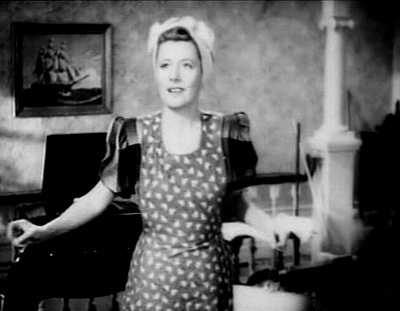


A few years ago, I tried to speculate why today's leading men avoid romantic movies like the plague. I cited Grant as an example from the past of an actor as convincing making love to a woman as when he's doing other things in the movies. In Serenade, he doesn't court Dunne as a sophisticated ladies man; he does it in an almost introverted way. He buys a bunch of records in the record shop she works in, even though he doesn't have a player, just so she can wait on him and they can talk longer.

Because this is Grant and Dunne, you expect some silly antics or witty banter, but they play it straight. Throughout the movie, Grant expresses his love for Dunne, in words and deeds, with a naked sincerity and passion rarely seen in today's leading men when their characters have wives or girlfriends...


...and that love is extended to their adopted child. Indeed, director George Stevens goes to great lengths to portray the reality of parenting: the hard work, the constant worry, the sacrifice, and how it can cause problems in a marriage. There's one extended diaper-changing scene, shot in real time with very limited cuts. Dunne is frustrated and nervous over the procedure, but Edgar Buchanan is calmly confident. I found it interesting that Dunne's character was so gung-ho about having a child, yet so clueless about how to care for it also. It's the sort of thing that makes you think parenting might not be for everyone...

Serenade isn't perfect. Spoilers for a 75-year-old movie to follow: in the scene that undoubtedly clinched the Oscar nod for Grant, he pleads with a judge to let him keep his adopted daughter. The judge insists it's a matter of law, but in the very next scene, there's Grant with the baby, happy and smiling. So much for the law! Also, it was shot from too far a distance. We really need to see Grant's face in close-up and we don't.


It doesn't matter, though, because later on, the child dies - off-screen! We find out in a letter Dunne writes to adoption agent Beulah Bondi, only Dunne's handwriting is a little on the fancy side. I had to stop the movie several times to read her letter! The death drives Grant and Dunne apart, but it's okay; Bondi finds a new baby for them at the last minute before they can break up. Hooray! Whatever.

Still, it's a good movie overall and a rare chance to see Grant not be Grant in a movie. Sort of.

-----------------------
Other Cary Grant movies:
Charade

Friday, November 25, 2016

By Any Other Name: Yeoh joins Discovery cast


Following yestrday's report that Star Trek: Discovery writer/producer Nicholas Meyer said Michelle Yeoh had been cast in the new series, her casting has been confirmed by two additional sources, and Yeoh herself has commented. Deadline claims that she will play Captain Han Bo of the U.S.S. Shenzhou, a ship key to Discovery‘s first season.
I had the impression the producers of Star Trek: Discovery were thinking not only big, but outside the box when it came to casting earlier this summer, when Angela Bassett was rumored to be up for the lead. They still haven't found their star, but with this week's announcement of Michelle Yeoh joining the cast, it sure sounds like they're still reaching for the stars, so to speak.

I've talked about my great love for Yeoh before, so naturally, I'm thrilled. She absolutely deserves to be working. I'm glad this will give her the opportunity. It sounds like her role will be that of a recurring guest star, like Louise Fletcher on DS9, for example. That's cool.

Yeoh is no stranger to sci-fi, either. She was in Danny Boyle's Sunshine, as well as, um... Babylon AD. I saw the former; if memory serves, I think she might've been captain of a spaceship in that, too. If she wasn't, then she should have been the captain! I thought the movie was okay. Not one of Boyle's best, but then, when your best includes Slumdog Millionaire and Trainspotting, the bar is set quite high.

While we're on the subject of Discovery, you may have heard Bryan Fuller stepped down as series showrunner, though he's still on board as an executive producer. It sounds as if perhaps he was feeling the pressure of getting the show out on time. The release date has been pushed back to next May. CBS' official line, however, is they're still happy with the series' direction.

Is there more to this than meets the eye? Probably, but we'll never know for sure. I do think the delay has the bean-counters a bit nervous, to say the least. This kind of thing happens all the time in Hollywood, though. Remember, the first JJ Abrams Trek movie was supposed to come out in December 2008. I have the T-shirt to prove it too!

-----------------
Previously:
Axanar and fan fiction
William Shatner's 'Leonard'
Two Nimoy docs
Lin brokers Axanar settlement
action Trek vs. mental Trek
the new fan film rules
Discovery to break the Trek mold
Star Trek at 50
Rod Roddenberry

Wednesday, November 23, 2016

Loving

Loving
seen @ Kew Gardens Cinemas, Kew Gardens, Queens NY

Through the years, most, but not all, of the women I've loved have been white. It's not a preference. It's a result of the circles I have run in, which almost always means I'm one of the few, if not the only, people of color. I make no apologies. I live in a highly multicultural borough in a multicultural city, but even with the advent of the internet, where I interact regularly with people from around the country, and the world, when it comes to sexual attraction, there haven't been many black chicks for whom I've fallen.

It's not something I care to think about much. If I were to be honest, yes, there's a small part of me that fears maybe it is a choice, and that this is somehow bad - as if I'm saying black chicks aren't good enough for me. I'm reminded of the line from the lesbian girl in Election (and I'm paraphrasing): "I'm not gay. When I love someone, I see the person. It's just that the person has always been a girl!"

Thing is, though, diversity has been the rule much more often than the exception in my life from the age of nine onward. In school, the groups of friends I ran with were always a mixed bag. Take high school: my clique consisted of a black (me), two Chinese, two Jews, two Filipinos and two whites whose ethnicity I don't know for sure because none of us ever gave a damn. My first girlfriend was half black, half white. My long-time buddy John is the same way, plus his wife is white. And now I have a Japanese brother-in-law.


I feel fortunate I live in a time where these sorts of pairings are more commonplace. (Not so much in the movies, though, but that's another story.) They're less of a big deal now than they were fifty or even thirty years ago. There are still haters, and yes, they've been making their presence felt more these days, but if you look at the long view, time is not on their side.

The struggle for acceptance of interracial marriage may not have been as high-profile as the fight for gay marriage, but obviously there are parallels. You can see them in the movie Loving, the story of the bi-racial Virginia couple whose legal struggle for equality took them all the way to the Supreme Court.


As with gay marriage, the mainstream in the movie feels the "sanctity" of marriage is being threatened, and law enforcement is used to push back, invading privacy and violating personal dignity. Also like gay couples back in the day, Richard and Mildred Loving have to meet clandestinely, and infrequently, if they want to be together, relying on secret rendezvous and go-betweens, always looking over their shoulders, never completely trusting of strangers.

Director Jeff Nichols, who continues to do no wrong, takes an unexpected approach by not giving us the passionate courtroom scenes, no great oratory from the lawyers or anything like that. He keeps the focus on the Lovings and their offspring. The result is a quiet, restrained, yet compelling film, with terrific performances from up-and-comers Joel Edgerton and Ruth Negga. I expect Nichols' original screenplay to get an Oscar nod, and it'll be well earned. It's been great to witness his progression as a filmmaker. This one will finally get him noticed.

Thursday, November 17, 2016

Arrival (2016)

Arrival (2016)
seen @ Cinemart Fiveplex, Forest Hills, Queens NY

One of the biggest complaints about movies or TV shows with outer space aliens is the artistic license granted to make extraterrestrials communicate with humans. As far back as the silent classic A Trip to the Moon, it was always taken for granted. Slowly, as our knowledge about the cosmos grew, and sci-fi literature became more popular, adjustments had to be made. In the 50s, aliens in movies always said something like, "We have studied your language" to at least pay lip service to the idea they're different from us.

Close Encounters had the clever idea of using light and sound as a basis for communication. Within the movie's context, its purpose was to indicate we are an intelligent species, even if we were incapable at the time of traveling who-knows-how-many millions of light years in giant Christmas-tree ornaments. Contact used prime numbers the same way - mathematics being a language all its own.

Arrival might be the first movie I've seen where humans make a concerted effort to decipher a written alien language; where it's the film's raison d'etre. I have to admit, half the time I watched it, I kept expecting Amy Adams to discover "to serve man" is actually a cookbook, metaphorically speaking, but the inevitable twist ending was quite different.


As a kid, I liked cryptograms. You know, where there's an encoded message, where X stands for A, Q for B, J for C and so on, and you have to decipher the code before you read the message. Sometimes entirely different symbols stood in for our familiar English alphabet. Sometimes, I'd try to make my own code, but I never had anyone with which to share the code. I liked cryptography as a game, a puzzle, but I never aspired to pursue it as a career.

The alien languages invented for fictitious books, TV shows and movies all have one thing in common: they require human actors to speak these words. Arrival acknowledges up front humans are incapable of speaking the aliens' language, therefore the need for a written language is established.


It's a clever conceit. I can't help but wonder if it could've been enough to carry the whole film. The climax of Close Encounters, after all, relied on that first contact moment. Here, Adams and Jeremy Renner succeed in that task, but then the stakes are raised. I can't say more without revealing spoilers, though I will say while I got the twist ending, I didn't grok whether it was something within Adams' character, or if it was the result of the aliens' intervention. It was pretty weird.

Monday, November 14, 2016

Tillie's Punctured Romance

Tillie's Punctured Romance
YouTube viewing

I'm currently reading a novel called Moviola, by Garson Kanin, notable screenwriter and playwright and husband of Ruth Gordon. It's an alternate history of Hollywood through the eyes of a fictitious studio producer. I'll have more to say about it after I'm done (it's over 400 pages, so it's huge), but the point for now is, it's valuable as a shorthand primer of classic American film. Naturally, the silent era is an important early section, and it's from here I was inspired to watch today's subject.

Tillie's Punctured Romance is an early Charlie Chaplin movie produced and directed by Mack Sennett. Early in his career, Ben, the main character of Moviola, worked for th eprolific comedy producer and was friends with Chaplin. In the book, we see Chaplin on the set of the film. The plot is... not easy to summarize. Basically, it's about a farm girl who runs away with a city slicker, unaware he and his actual girlfriend are out to fleece her. There's some stuff with a rich uncle, and because this is a Mack Sennett movie, there are Keystone Kops.

Chaplin is not yet the familiar tramp character he would later become world famous for playing. In fact, his character here is quite a cad. He two-times the women he's involved with, starts fights with strangers, he even treats kids with disdain - but it's all in the name of laughs.


Mabel Normand is his accomplice. I've talked about her before, and now, as before, I found her appealing. In Moviola, she and Fatty Arbuckle are friends and business partners with Ben. She's also credited, by the man himself, with giving Chaplin confidence in front of the screen in his early years. They're quite good together in Tillie.

The real star of the film, though, is Marie Dressler as Tillie. This was the first silent film I've seen her in, and oh my god, what a revelation it was. Tillie was based on a Broadway play she had starred in, so one would expect her to know the character, but at age 46 and tipping the scales at what had to be at least 200 pounds from the look of her, she could hardly seem credible as a farm "girl" at first blush... until you watch her in action.

Dressler was not an attractive-looking woman by any stretch, yet the physicality and vitality she brings to the role of Tillie is that of a woman half her age and size. Tillie is a fully-realized, three-dimensional woman. She's coquettish, flirtatious, temperamental, bossy, hysterical, and above all active throughout the movie. She rarely stays still. Lacking the means to speak to the audience, Dressler uses her entire body and face to communicate, and she is eloquent. 


And you should see her dance! Dressler was no Ginger Rogers, but in Tillie, she's surprisingly light on her feet and radiates a spirit of pure, unself-conscious joy that is delightful to watch. The net result is Tillie, and Dressler by extension, acquire a kind of beauty uniquely her own. Mae West's beauty came from the way she carried herself, how she talked and especially how she walked. No one in Hollywood was like her. With Dressler, in this film at least, it's a similar idea, substituting laughs for sex appeal.

The version of Tillie I saw didn't have as many title cards as I would've expected. As a result, it was difficult at times to figure out what was going on. Beyond a certain point, though, it hardly seems to matter. Things get more and more zany and the principal characters keep up as best they can. In the end, despite the plot holes and leaps in logic, it's an enjoyable film all-around, exactly the kind of film I needed right now, as you can imagine.

Sunday, November 13, 2016

Roustabout

The At the Circus Blogathon is an event devoted to movies set at circuses, carnivals and freak shows, hosted by Critica Retro and Serendipitous Anachronisms. For a complete list of participating bloggers, visit the links at either site.

Roustabout
Netflix rental

Carnivals! Everyone loves them, right? I was no stranger to them as a kid. One came to the Shea Stadium parking lot every summer when the Mets were on a long road trip. I'd get my father to take me when I was little, and when I was older, I went by myself or with friends.

My favorite ride has many names, but it's basically a centrifuge: you get strapped into a great wheel that spins round and round. The pressure builds up and flattens you against the wall. I never had much of an interest in midway games unless they came with a joystick.

In New York, street fairs abound all over the five boroughs in the warm months. They tend to sell the same things no matter where you go: cheap jewelry and handbags, plus zeppoles and corn dogs to eat. I always look for used CDs and books.


Perhaps the most notable street fairs in New York are the San Genaro Festival in Manhattan and the Atlantic Antic in Brooklyn. The former is more like a real carnival, with midway-style games and the occasional ride or two, like a small ferris wheel or a motion simulator ride. Remind me to tell you one day about my San Genaro stories: one about my unfortunate encounter with two racist girls, the other about my attempt to win a pair of rollerblades.

In Columbus, I attended the State Fair. Being the city slicker I am, I had expected to see things like pie-eating contests and pig pageants (like in Charlotte's Web!). Truth was, it was much more like the carnivals I knew growing up, only much larger. I believe they offered helicopter rides! I was gobsmacked, however, at the array of things people are willing to fry, and sell, and eat. Fried Oreos? Fried Twinkies?! I'm here to tell you they exist.


It so happened that Melissa Etheridge was in town for a concert that night, and there was a contest for free tickets at a stage. I've been a fan since high school. Of course I had to enter. All I had to do was get up on the stage and, um, sing... for a minute or two. The audience judged the winner. I didn't decide just like that; I was alone and sober and didn't have anyone egging me on or talking me out of it, as it were. In the end, it came down to me wanting those tickets really bad.

I sang one of her songs; I forget which. I remember trying not to look at the audience too much. I basically closed my eyes and thought of England. I gave it everything I had, which wasn't much to begin with - my sister's the singer in the family, not me - and I lost. What the hell. YOLO, amirite?


Anyway. Wikipedia defines the word "roustabout" as "a traditional term used to describe a fairground or circus worker." These days, the word defines laborers on oil fields and rigs. The almighty Google oracle also tells me there's such a thing as a Roustabout Circus, in Alaska, but it doesn't look like it's a place for roustabouts to perform.

Further web exploration reveals within the context of a circus or carnival, a roustabout is usually a temp, unskilled or semi-skilled, that sets up and breaks down the tents and booths and rides, cleans, performs maintenance, stuff like that. It's not unlike being a roadie for a concert.


Okay... I've put it off long enough. Time to talk about Roustabout the movie. As a thespian, Elvis doesn't embarrass himself here, but the script doesn't exactly challenge him, either. He basically cashes in on his bad boy image once again which, by 1964, was beginning to grow a bit stale (he was 29 when he made this one). Still, the movie soundtrack went to number one in the year of Beatlemania, so 50 million Elvis fans... you know the rest.

He doesn't do much actual roustabout work (though we do see him help assemble a ferris wheel); he's too busy macking on the ladies, riding his motorcycle in an outfit he stole from Marlon Brando, and of course, singing songs. I am pleased to report he gets slapped no less than three times in the film. But enough about him...


...let's talk about the real reason I chose to watch this movie: BARBARA STANWYCK! Missy made this a year before The Big Valley debuted on TV. They originally wanted Mae West, if you can believe it, but allegedly, she wanted to be one of Elvis' love interests. That might not have been a bad idea... if she wasn't close to seventy years old at the time. (Then again, this is Mae West...!) The filmmakers said no.

No one watching Roustabout will forget Double Indemnity or The Lady Eve or Stella Dallas. Stany probably did this to pay the bills. That's okay. We love her anyway. Elvis holds his own in his scenes with her, though again, it's not a challenging role. It's more than a little surreal to watch the two of them share a screen. It's like, say, Helen Mirren acting a scene with Kanye West. Sadly, there's not a whole lot of Stany in this flick, either... but hey, the songs are decent. (Also, Richard "Jaws" Kiel as a strongman at the very end.)

John, Sue and I watched this on Netflix and we all got a kick out of it. There's one song with the lyric "popcorn, peanuts" and John thought Elvis said "penis" instead. He kept goofing on that for the rest of the movie.

----------------------
Related:
5 movies set at World's Fairs

Other circus, carnival or freakshow movies:
Freaks
Nightmare Alley
He Who Gets Slapped
Laugh Clown Laugh

Friday, November 11, 2016

The Gathering of the Greatest: HB's 'Super Adventure'

The One of My All-Time Favorite Cartoons Blogathon is exactly what it says on the tin. It is hosted by Movie Movie Blog Blog. For a complete list of participating bloggers, visit the link at the host site.

First, we have to talk about the main title.

I mean, I could spend this entire post talking about the main title. It's tempting, but I won't. We really do have to start there, though.

Picture the following scenario in your mind. I must insist you do this because it will help you get into the proper frame of mind to best appreciate today's topic.

Okay. You are ten years old. You are beginning to get into superheroes for the first time. You've already dipped your toe into the world of Marvel Comics and are still wading in the shallow end. You've seen Superman on TV and loved it, though even at that age, you have the vague impression a superhero movie like that only comes along once in a generation. You dig Spider-Man and his Amazing Friends, but even as a kid, you can sense its cheesiness. Superfriends might be better if they weren't trying to teach you a lesson all the time. Battle of the Planets rocks, but to watch it, you have to get up at 5:30 in the morning.

So one bright Saturday AM, you go into the living room with your bowl of Fruit Loops, plop down on the couch, turn on the TV, and see THIS: