Monday, August 5, 2013

Behind the Candelabra

Behind the Candelabra
seen @ Elinor Bunin Munroe Film Center @ Film Society of Lincoln Center, New York, NY
8.3.13

So earlier this year Steven Soderbergh got in front of a microphone and said a bunch of things about what's wrong with modern moviemaking. He's a successful director, he's been in the game a long time and he's made movies both with and without the studios. Personally, I haven't been as interested in his output in recent years (one can only see so many movies), but I respect his knowledge about the industry and I have no doubt that he spoke from a position of authority. 

Much of what he said is not news to anyone who pays attention to what goes on in Hollywood these days: studios prefer to play it safe regarding story content in order to appeal to a wider, international audience; one can't always rely on test screenings to determine success; there's less of an effort to make long-term investments in young talent; and more indie movies are competing for a smaller slice of the box-office pie.


At one point he briefly made a reference to Behind the Candelabra, the Liberace biopic that played on HBO because he couldn't get a theatrical release for it. He explained part of the reason why from a economic perspective:
...Point of entry for a mainstream, wide-release movie: $30 million. That's where you start. Now you add another 30 for overseas. Now you've got to remember, the exhibitors pay half of the gross, so to make that 60 back you need to gross 120. So you don't even know what your movie is yet, and you're already looking at 120. That ended up being part of the reason why the Liberace movie didn't happen at a studio. We only needed $5 million from a domestic partner, but when you add the cost of putting a movie out, now you've got to gross $75 million to get that 35 back, and the feeling amongst the studios was that this material was too "special" to gross $70 million. So the obstacle here isn't just that special subject matter, but that nobody has figured out how to reduce the cost of putting a movie out.
And by "too special," he means too gay.

I'll admit it: while I am 100% behind gay rights, be it in marriage or anything else, my mind could be a little bit more open when it comes to the everyday reality of gay life. It was a shock to see Matt Damon reaming Michael Douglas in this movie (it wasn't explicit, of course, but the way it was shot still made it pretty damn obvious). Gay sex is not a sight I'm familiar with. Yeah, we used to laugh and make jokes about gay porn when I worked in video retail, and once in a blue moon, late at night, we'd even put a tape on for a minute or two when the boss was long gone, but that's not quite the same thing. 


In Candelabra, it's in the context of two men who genuinely love each other, and I suspect that may be something that gets lost whenever a film about gay people comes up: some only see the sex act and not the love. Like many people, I had been conditioned to think that homosexual love was unnatural, and while I now know otherwise, it's still gonna take time to overcome that mentality.

The extraordinary nature of this film, however, enabled me to see the love these two men had for each other. I was jealous! I wish I had a love like that. Yeah, Liberace got all possessive and started fooling around with other dudes later on and that wasn't cool; and Scott Thorson let himself be molded in Liberace's image, and that was just bizarre, but it was clear that there was something deep between the two of them, if only for a little while. 


Besides, I understand what it means to let yourself be manipulated into doing unusual things by someone if it means getting to be with them, to love them. I understand giving so much of yourself to someone to a degree that may not be entirely healthy. I don't think one needs to be gay to get something like that, and that's what ultimately matters, because gay love is not that different than straight love where it really counts. The Supreme Court finally realized that, and more and more Americans are realizing it too.

I saw Candelabra at the Film Society of Lincoln Center. This was the first time I had been there. They're currently showing recent HBO movies for free throughout the month, and this was the first one in the series. Hadda wait on a long line for them to give out free tickets. This is a classy joint, which isn't surprising. I used to go to high school near Lincoln Center, and even though they've made some changes to the surrounding area since, I still see it the way I did back then.


The screening room was nice. Wooden floor and walls with long, cushioned benches arranged stadium style, and low-angled steps. The air-conditioning was aggressively employed. I didn't eat, but there was a small cafe on the opposite side of the lobby. The lobby itself had autographed posters of famous film directors from around the world. A British dude who was part of the FSLC staff introduced the film, talked about other exhibits. Instead of a canvas, there was a giant video screen on which Candelabra played. Audio was perfect. Nice place. I'd go back there.

Friday, August 2, 2013

A Foreign Affair

A Foreign Affair
seen at Bryant Park Summer Film Festival, Bryant Park, New York NY
7.29.13

I've always had a bit of a hard time with Marlene Dietrich as a sex symbol. Was she beautiful? Of course. Her beauty, however, was quite different from that of a Rita Hayworth or an Elizabeth Taylor. I've read the stories about how much she managed her looks, to the point of even advising her directors on how to light her properly. She was way ahead of her time in many ways, and you have to respect that.

She never really struck me as being that sexy, though. She reminds me of Mae West in that they were actresses with unconventional looks who made themselves sex symbols through careful cultivation of their image. Of course, it helped that they worked during a time when definitions of feminine beauty were not quite as rigid as they are now.


I dunno. Maybe I haven't seen enough of her films. A few months ago, I had the privilege of seeing The Blue Angel in 16mm. I thought about writing about it, but I honestly was not sure what to make of it, it was such a strange movie. I've seen Witness For the Prosecution, of course, and she's awesome in that. While I have no problem watching her in a movie, I can't quite buy into the idea of her as a sexy siren. Maybe it's the cheekbones. Maybe it's that perpetually languid look in her eyes.

It's definitely not the singing. In A Foreign Affair, Dietrich gets to sing three songs, but, as was typical of her, she didn't sing so much as sing-talk, which can often be really annoying (see Harrison, Rex). Maybe German audiences found that alluring, but I can't say I do. And besides, Madeline Kahn kinda ruined any possibility of me taking it seriously. It sounds like I'm putting Dietrich down, I know, and I'm totally not. Like I said, I respect her for being a true Hollywood original and a cross-cultural icon. I probably just need to see her in other stuff.


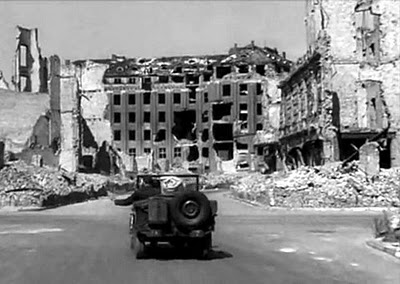
Affair centers around a US congresswoman sent to post-war Berlin to assess the morale of American troops, only to discover that an officer may be having a secret relationship with an ex-Nazi. The film is special in that we get to see images of Berlin only a few years removed from the war's end. Jacqueline goes into more detail about the movie, and she makes it sound so much better than my impression of it...

... because of where I saw it. The volume at Bryant Park was quite loud, as it needs to be to accommodate such a large crowd, but loud doesn't always equal clear. As a result, I found I had to focus more. Failing that, I relied on the close-caption screen to my left. This was the first time I had sat near this screen at a Bryant Park screening, and I was surprised to see that the captioning was being done live. A real person was typing the dialogue as it happens. Then I realized why: this was an actual 35mm print being shown. I'd gotten so used to seeing DVDs at outdoor screenings, where one can turn on the subtitles, that it was a bit of a shock to see that we were watching actual celluloid. Kudos to the Bryant Park Film Festival people, I guess.


Affair is a comedy, but I didn't find it that funny, and I suspect the reason why had to do with the sound. As usual, I was at the back end of the lawn, although I was closer to the gate than I was for Hush Hush Sweet Charlotte. This is a Billy Wilder film, so that means dialogue is vitally important, and while I was able to follow the plot, I wanted to do more than that. You'll note that in Jacqueline's post she touches upon aspects of the dialogue that I either missed or that I didn't get the full impact of. 

And of course, there were people talking. In this case there was a family to the right and behind of me, complete with little brats kids having a pizza dinner and not caring about the film at all. They weren't there at the beginning and they didn't stay that long, but they forced me to move my seat anyway.


I thought about the differences between Bryant Park's film series and that of Brooklyn Bridge Park, another highly popular venue - besides the obvious one of classic films versus modern ones - and I think an important one is that of location. Bryant Park is nestled right in the heart of midtown Manhattan, a stone's throw from Times Square itself. One can hear the traffic from all sides, and more importantly, it's easily accessible, meaning anyone can wander in from off the street: homeless people, tourists, families eating dinner who don't give a damn about the movie being played, etc. By contrast, the lawn where the films play at BBP is more isolated. It requires you to come to it, as opposed to it just being there, so there's a greater likelihood that everyone who's there is there for the movie and not anything else.

Of course, if I sat within the lawn again, this might not be an issue, but like BBP, I'm slightly uncomfortable being surrounded by so many people at such close range. Especially when I'm by myself! This is something I'll have to re-consider for next summer, I think.

Thursday, August 1, 2013

Smurf these smurfin' links

Not a whole lot to talk about this time out, except to mention that once again I'll be taking part in the TCM Summer Under the Stars Blogathon this month. Last year, I made an effort to make each of my posts different from each other, and I'm gonna do the same this year, even going so far as to play with the format a little bit. Also, last year I chose to pick one actor whom I had never heard of before, or at the very least, knew next to nothing about. That was Jeanette MacDonald. I've done the same this year, so that entry will probably be the most straightforward one.

I have more outdoor movies to look forward to this month, including a couple at some brand new (to me) locations. I'll try to take some more pictures of them for the WSW Facebook page. I had taken some shots of Prospect Park and Bryant Park, but they weren't all that exciting upon reflection. I loved the Riverside Park pictures (as well as last year's shots from Red Hook) so much because they were taken at a venue more conducive to exciting shots - in my opinion, anyway. You can still see the Riverside shots on the Facebook page if you scroll down a little. If you like the pics, let me know.

Lot of links this time:
Courtney writes about how "stingers," or after-credit scenes in genre movies, have gotten out of hand.

Jacqueline has the story of a director who started out in the early days of the auto industry.

The Lady Eve writes about one of my all-time favorite TV shows, The Honeymooners.

I just started reading a great blog called Pre-Code.com, which covers the pre-Code era in classic film. Here's one sample post, on the Barbara Stanwyck film So Big!

Raquel has an interview with the creator of a graphic novel about an imaginary tale of a young Buster Keaton.

And then there was the time, Aurora says, when Gracie Allen ran for president.

Will put together a great report on the "Hitchcock 9" screening at BAM earlier this summer.

Why does it seem like white people don't like black movies? It's not an easy answer.

Could this book be the reason why so many movies seem the same lately?

And speaking of comics, here's how the creators of the 2 Guns graphic novel are actually making money from the film.

Wednesday, July 31, 2013

Books: Twinkle Twinkle Little Star


The 2013 Summer Reading Classic Film Book Challenge is an event in which the goal is to read and write about a variety of books related to classic film, hosted by Out of the Past. For a complete list of the rules, visit the website.


I recently shared a link to an article written by former child star Mara Wilson, from the films Mrs. Doubtfire and Matilda, among others, in which she talks about the hazards of achieving fame at such a young age. Celebrity can be a daunting enough prospect to face even as an adult. As a child, one can only imagine how much greater the weight of expectations and responsibilities can be. We naturally tend to think, however, that, as with many things, the modern-day version of fame is more complex than it was in the old days. In the case of Hollywood, however, that may not be completely true.

Twinkle, Twinkle, Little Star (But Don't Have Sex or Take the Car) is a memoir by Dick Moore, who, under the name Dickie Moore, had a prolific film career during the 30s and early 40s as a child, appearing in such films as Oliver Twist, Blonde Venus, So Big, The Life of Emile Zola, Sergeant YorkHeaven Can Wait and Out of the Past. He also appeared in films and TV shows as an adult. In addition, he's notable for giving Shirley Temple her first on-screen kiss, in the film Miss Annie Rooney. In this book, Moore not only explores the realities of life as a child star in Golden Age Hollywood, he also interviews a number of his peers from the same era and gets them to share their experiences as well.


Dick(ie) Moore
The differences between being a film child star then and now are profound, and reflect the changes in American society. The 1930s, of course, was the time of the Depression, and many of these child actors were making more than enough money to support their parents. Films with juvenile movie stars were a major trend, and they were cranked out at a rapid clip. They were looked upon as a panacea for a moviegoing audience that needed to feel good in the worst way, and as a result these kiddie thespians were almost as revered as their adult counterparts.

With that success, though, came more than its fair share of drawbacks. Often, the kids were isolated from not only their peers, but from the rest of society at large. Their natural psychological development was impaired because the studios made every effort to preserve their juvenile image for as long as it was profitable, often with the endorsement and encouragement of their parents. And once they finally did grow up, many found it difficult to not only sustain their careers, but to successfully integrate into real life.

Moore recounts his experiences with great candor, as do his fellow child stars, which include Shirley Temple, Jackie Coogan, Natalie Wood, Donald O'Connor, Mickey Rooney, Margaret O'Brien, and many more. There are the usual saucy and surprising behind-the-scenes stories, but there's also a lot of self-reflection as to what this kind of life was like, and what it did to them. Some of the tales are quite tragic, but there's plenty of humor and fondness as well.


I bought Twinkle used, at the Strand in Manhattan. I would've passed on it except I distinctly remember reading about this book on another blog, and for the life of me, I can't remember which one. It may not have even been a classic film blog; I'm not sure, but I remember reading about it and finding it interesting, and that's what made me get it.

This particular edition came with a surprise. Apparently this copy was the property of the late film critic Judith Crist. Her name is written on the endpage. She died almost a year ago, so I can easily imagine her family going through her things and selling off her books, including this one. I have an extremely vague recollection of seeing her name around as a kid, on movie posters and perhaps in print, but I don't recall ever being familiar with her writing.


"Dear Judy & Bill - This is for the folks who have
nearly everything - Love - Dot & Mur 7/84"
But check this out - between the pages of Twinkle were all these promotional press releases and photos for the book, which came out in 1984. There's an interview with Moore; it's just the usual promo stuff, nothing particularly noteworthy. The pics are of Moore then and now. In addition, there's some personal stuff: an anniversary card addressed to Crist and her husband Bill from two someones named Dot and Mur. Couldn't begin to imagine who they are. There's also a program book from a dedication ceremony for a school in Canada. I can't tell what Crist's connection to this was, if anything. Obviously this is one of those chance occasions that makes used book stores so special.

Anyway, Twinkle is an excellent book, and you should definitely check it out, even if the version you get has no memorabilia of any kind inside it.

----------------------
Previously:
For Whom the Bell Tolls

Monday, July 29, 2013

William Castle and his gimmicks

The William Castle Blogathon is an event honoring the life and career of horror film director William Castle, hosted by The Last Drive In and Goregirl's Dungeon. For a complete list of participating bloggers, click on the links to either website.

I had probably heard of director William Castle somewhere within the past three years of doing this blog, though I doubt I could've told you much about him aside from "He was the horror director with the funny gimmicks." Last Halloween, I had the great privilege of seeing one of his films, Homicidal, at a theater, the fabulous Loews Jersey City, that recreated the gimmicks used upon the film's original release. As a result, it greatly increased both my awareness of and appreciation for the man. Besides, he comes across as such a kindly, lovable (if slightly unhinged) old coot, in an Addams Family kind of way, doesn't he?

As I alluded to in my post on the movie, Castle's huckster promotions may seem corny now (and they probably seemed corny then), but give the guy credit for understanding that movies are entertainment and don't need to be taken quite so seriously all the time. That's something I fear gets forgotten quite often these days within not only horror movies, but genre movies in general. Many of them strive for what they consider a greater sense of "realness" that they forget the reasons the audience pays their money: they want a good time. The best genre movies, I believe, find the right balance between legitimate thrills and playfulness.

Castle's Wikipedia page lists eleven different gags that he used over the course of his career. Here are five examples of his most memorable ones. Granted, these probably should be experienced within the context of the movies instead of separately, but how often do Castle's movies get shown at all, much less with the accompanying gags?


- Mr. Sardonicus. Punishment or mercy for the title character? The audience decides thanks to a bunch of glow-in-the-dark cards that they hold up, and presumably, the projectionist would run the ending they choose. Of course, it doesn't help that Castle himself tended to encourage punishment when he appears on screen to explain this poll. Supposedly there was a "mercy" alternate ending, but historians are unsure.

Test screenings, of course, are common in the industry and have been for a long time, and they can lead to changes in the movie itself. When I went to a private screening of the Steve Martin comedy The Big Year, they gave us cards to fill out afterward, asking us what we liked, what we didn't like, what we'd change if we could. I didn't care for the movie much, and my comments reflected that (though I tried to be kind), but I suspect the filmmakers tinkered with the film for a long time, because it was almost an entire year before it was released.

Castle's gimmick isn't quite along the same lines; it's got more of an instant-gratification vibe to it, which perhaps suits this modern generation better. Who knows - if the talk of a possible "Choose Your Own Adventure" movie is true, maybe this kind of gimmick is poised for a comeback.

Castle's "punishment or mercy" poll


Homicidal. The "Coward's Corner" is something I could easily see being abused even back then, but again, it's about entertainment. If I had been around for this on its initial release, I would see the movie once, then see it again with friends just so we could make asses of ourselves and run out of the theater and get our Coward's Certificates. In fact, this was likely the sort of thing me and my high school friends might've engaged in if we knew about this movie and were in on the gag.

When I saw this at the Loews, there was an obvious plant in the audience who ran screaming out of the theater just so someone could do it. It got a lot of laughs; everybody realized it was all in good fun. Unfortunately, the tenor of many horror movies these days seems completely at odds with such a gag. The metaphysical, self-aware nature of the Scream films come close to capturing that spirit. Maybe there are other recent horror films that do the same. Not being a big horror fan, I wouldn't know.

The Homicidal "fright-break"

Macabre. The first of Castle's movie gimmicks, he claimed to offer attendees a certificate for a $1000 life insurance policy from Lloyd's of London in case the film made them die of fright. There were also "nurses" in the lobbies and hearses parked outside the theaters. This sounds pretty cool. If it were done today, though, they'd have to be sexy nurses, of course - I'm sure lots of guys would fake a heart attack just so they could get some mouth-to-mouth resuscitation, if you know what I mean...

In our litigious society, however, I wonder what would happen if someone really did get a heart attack? Sure, this can easily be made to come across as being tongue-in-cheek (especially with sexy nurses), but all it would take is one person with no sense of humor to sue the studio and there goes the gag. Studios are risk-averse enough as it is these days.

Director John Waters talks about Macabre

- House on Haunted Hill. Inflatable glow-in-the-dark skeleton? Excellent! If the remake used this, it would've made way more money. I could easily imagine this scaring the pants off of me in 1959... if I could imagine living in 1959. It's not much of a scare today, especially after seeing it in action in this video, but it's still a great idea, especially for a midnight screening. (Come to think of it, most of these films would make for excellent midnight screenings!) Bonus points for the name "Emergo" and of course, for Vincent Price. Apparently the Loews did this gag too, a couple of years ago. I wish I had been there for it! 

I realize there are only so many ways to make a skeleton scary-looking, but I keep thinking there should be more to this gimmick somehow. If it were a surprise, that'd work, but thanks to the internet, it's next to impossible to keep anything a secret for long. Still, I like the idea of it. I just wish it could be jazzed up somehow for maximum scare potential, in a way that didn't involve modern 3D!

Emergo in action

The Tingler. Oh my god, are you kidding me? Vibrating motors hidden under the seats that go off during the scary moments? This kinda reminds me of how they recently tried to install some kind of seats in select theaters that moved around and did crazy stuff to simulate the action scenes in movies. It didn't catch on, obviously, and if it did, they'd probably charge extra for it like they do now for 3D movies. But if I had been there for this back then, I'd have been screaming my head off like a lunatic. Once again, cool name ("Percepto") plus Vincent Price equals WIN.

This seems like the best of the gags to me. There's an element of surprise (will the Tingler be under your seat?), a physical reaction that one can't prepare for, and a full level of audience involvement. But I can also see the drawbacks: people figuring out where the Tingler seats are and bogarting them, or worse yet, posting the locations online; fights over Tingler seats, which could lead to them getting damaged. In the end, it might be more trouble than it's worth.

Castle's introduction for The Tingler

It's kind of sad that there's no interest in this kind of filmmaking and promotion in modern film, don't you think? By the same token, though, because modern audiences have become savvier and more aware of what goes on behind the camera, it's harder to lose oneself to the gags and the innocence of the spirit in which Castle made these gags. 

If Castle were around today, he'd likely be embraced by the Ain't-It-Cool and Comic-Con and SXSW type fanbase, but he'd have to work a hell of a lot harder to maintain their interest. The marketing of a film like The Blair Witch Project was a huge part of its success, but gimmicks like that are difficult to maintain over a career, which is why one only sees something like that once in a blue moon, if even that. Castle was fortunate to have made his movies when he did, I think.

Tuesday, July 23, 2013

Pacific Rim

Pacific Rim
seen @ UA Midway Stadium 9, Forest Hills, Queens, NY
7.17.13

I had very few action figures as a kid. The type of toys I tended to favor were building toys: Lincoln Logs, Tinkertoys, domino obstacle courses, stuff like that. I definitely don't remember clamoring my parents for action figures, which is odd, since I'd see them in the Sears fall catalog every year, which I always closely scrutinized. In a way, I kinda regret that. I feel a little bit like I missed out.

Watching Pacific Rim, one gets the impression that director/co-writer Guillermo Del Toro probably had action figures as a kid... and he probably liked pitting his Gundams against a Mothra or a King Kong or what have you. I read a recent interview with him in which he said how some people think he makes two kinds of movies; one kind for the studios (Hellboy, Blade 2) and one for himself (Pan's Labyrinth, Cronos), when in fact, he says, they're all the kinds of films he wants to make.


He couldn't be making them at a better time. Geek movies, and geek moviemakers, rule Hollywood right now, but Del Toro is unique in that the majority of the films he has written are based on original properties, as opposed to those based on comics or novels or video games. 


As a result, a film like Pacific Rim, one without stars and that doesn't come with a pre-established audience, lives or dies primarily on the strength of Del Toro and his reputation. And while it's doing okay at the domestic box office so far (internationally, it's another story), it hasn't been as big a breakout movie as comparable films like Iron Man 3 or Star Trek Into Darkness, films with well-established audiences.

It's unfortunate that original properties are harder sells in Hollywood than adaptations - not just for genre films, but all sorts of films. Every franchise, after all, began with somebody taking a chance on someone else's original idea, no matter where that idea originated. Original ideas, though, are considered risky in today's Hollywood, and that bodes ill for its future. But that's another post.


Pacific Rim, derivative and cliche as it was in places, was still fun to watch. We get to see not only the robot-monster fights, but the way the world has changed as a result of their presence, which I liked seeing. Also, it was a refreshing change to see an action movie this summer that didn't take collateral damage for granted. For instance, did you notice the moment where one of the giant robots actually bothers to step over what looked like a pedestrian walkway while searching for the giant monsters? 


Del Toro also said in another interview that he felt it was important to make an action movie that wasn't America-centric, one which was more multi-national, and that's certainly a worthy idea - not only because Hollywood is catering more to international audiences these days, but because it simply makes sense. The Kaiju monsters, after all, don't recognize borders, and besides, it gives us an opportunity to see different kinds of actors. 

For instance, I had never seen Rinko Kikuchi before (she was Oscar-nominated for her role in Babel) and I liked her. Well, I thought she was really cute, mostly, but I would welcome seeing her again in the right movie. Plus, this was the first time I got to see Idris Elba with his British accent, even if he did ham it up a lot. In a summer of action movie disappointments, Pacific Rim... met expectations, if not exceeded them.

Monday, July 22, 2013

Big Words

Big Words
seen @ AMC Empire 25, New York, NY
7.19.13

On the night of November 4, 2008, I was in Columbus, Ohio, watching the presidential election on my roommate Max's laptop computer. I had cast my vote weeks in advance. It was Max's idea and I thought it was a pretty good one. I was still relatively new to the city and I guess I believed it would be better than voting on Election Day itself, especially since I was living in a so-called "swing state" and every ballot would really count, more so than in a traditionally pro-Democrat state like New York.

I had the privilege of seeing Barack Obama speak in public. I think I may have talked about that here before, but basically, it helped solidify my vote, which was leaning toward Obama anyway. Max was always for Obama, whereas until that point, I only knew I didn't want John McCain. I felt fairly confident that Obama would win, but come Election Day, I was still nervous. Max, by contrast, never had a doubt. Max worked nights (probably still does), so we only watched a little bit of the CNN coverage before he had to leave, which was a little disappointing. If indeed history was going to be made, I didn't want to experience it alone.


I did, however, and considering how emotional I got once the results were made official, maybe it was better that I was alone! I don't remember how much celebrating there was in the streets outside our apartment, though I'm sure there was some. It did feel odd, experiencing such a major turning point in American history in a strange city, a place that wasn't quite home yet. Living in New York, it becomes so easy to think of it as the place where everything happens, the place everyone pays attention to...


...but if my time in Columbus taught me anything, it's that New York is not the be-all and end-all to American life. While in Ohio, I got a taste of Midwest politics. I met and spoke to quite a few conservatives - Max's parents, for starters. I saw how the media there differs from that of NYC, and through my involvement in livable streets activism in general and bicycling in particular, I saw what Midwesterners value. It was a valuable education, one I wouldn't trade for anything, and one I definitely wouldn't have gotten had I stayed in New York.

Big Words is a film set in Brooklyn on the eve of Obama's election to the presidency. I didn't think much about my memories of that night while watching it, mostly because outside of the event itself, it wasn't that memorable for me. The story centers around three friends who once formed a rap group before breaking up, and how time and tide has changed them in the intervening years. I had expected more of a balance between the micro story, the three friends, and the macro story, the election - perhaps how one reflects on the other, or something like that - but as it turned out, the "micro" story was the "macro" one all along. I found that a little bit disappointing, but not much.


I've written before about growing up with hip hop music. The era Big Words references is the early 90s, and by that time I had already grown apart from the music. Hip hop had already grown into something I didn't recognize and didn't enjoy as much, so I didn't feel any sense of nostalgia while watching the film.


I liked Big Words well enough, but it didn't strike me as being as great as other AFFRM-distributed films such as Restless City and Kinyarwanda. There's a fair amount of cynicism expressed about the music business (and rightly so, perhaps). Two of the main characters are gay, so that alone adds an extra layer of dimension to a film like this. The film rambles a bit before it gets to its big confrontation at the end. 

If this doesn't sound like a ringing endorsement, well, maybe it's not, but only because the AFFRM films have set the bar for black films so high. Big Words is better and smarter than most black films put out by Hollywood - hell, most Hollywood films, period - and I'd recommend it for that alone, but in a year which includes the incomparable Mother of George, plus Fruitvale Station, which is touted as a major Oscar contender, this one can't help but pale in comparison a bit.